If your dog turns into a snarling, lunging mess every time another dog crosses your path, you already know the feeling — that jolt of dread the second you spot another leash on the horizon How to Stop Dog Aggression Towards Other Dogs. You’re not alone, and more importantly, you’re not out of options. Stopping dog aggression towards other dogs is one of the most common (and most solvable) behavior challenges dog owners face, and with the right approach, most dogs can learn to walk past, greet, or simply coexist with other dogs calmly.
This guide breaks down why dog-to-dog aggression happens, how to recognize the early warning signs before things escalate, and a realistic, step-by-step plan you can start using today. We’ll also cover when it’s time to bring in a professional, because some situations genuinely call for expert hands-on help.
Why Do Dogs Become Aggressive Toward Other Dogs?
Aggression is rarely random. It’s almost always a symptom of an underlying emotional state, and understanding the “why” changes how you approach the “how.”
Fear-Based Aggression
This is the most common cause. A dog who feels cornered, overwhelmed, or unsure of another dog’s intentions may growl, bark, or snap purely as a defense mechanism. Fear-based reactivity often stems from a lack of positive exposure to other dogs during puppyhood, a single frightening encounter, or general anxiety in unfamiliar situations.
Poor Socialization
Puppies have a critical socialization window, generally between 3 and 14 weeks of age, during which positive exposure to other dogs shapes how they interpret canine body language for life. Dogs who missed this window — including many rescues and dogs isolated during early life — often struggle to correctly read other dogs, misinterpreting normal greetings as threats.
Leash Reactivity vs. True Aggression
Many dogs who appear “aggressive” on leash are actually perfectly fine off-leash at the dog park. This is called leash reactivity or leash frustration, and it happens because the leash removes a dog’s ability to flee, greet properly, or create distance — so barking and lunging become the only outlet.
Resource Guarding
Some dogs are only aggressive around specific triggers: food, toys, a favorite person, or even a particular doorway. This is resource guarding, and it’s distinct from general dog-to-dog aggression, though the two can overlap.
Pain or Medical Issues
Sudden-onset aggression, especially in an older dog or one who previously got along fine with others, can sometimes be linked to pain, hormonal changes, or an underlying medical condition. Any abrupt behavior change is a signal to consult your veterinarian before assuming it’s purely behavioral.
Recognizing the Warning Signs Before a Reaction
Dogs rarely go from calm to aggressive with no warning — they just give warnings most owners miss. Learning to spot these signals early lets you intervene before a full reaction happens.
Watch for:
- Stiffening body posture — a dog who suddenly freezes or goes rigid
- Hard, fixed stare at another dog, often with the whites of the eyes visible (“whale eye”)
- Raised hackles along the back of the neck and spine
- Lip licking or yawning out of context — common stress signals, not tiredness
- Low, slow tail wag combined with a tense body (very different from a loose, full-body wag)
- Ears pinned back or forward and rigid
- Excessive panting when it’s not hot and the dog hasn’t been exercising
Catching even one or two of these signs gives you a window to redirect your dog’s attention before barking or lunging starts.
Step-by-Step Plan to Reduce and Stop Dog-to-Dog Aggression
There’s no overnight fix, but consistent, structured training produces real, visible progress in most dogs within 4 to 8 weeks. Here’s a practical framework.
Step 1: Manage the Environment First
Before training even begins, reduce your dog’s exposure to triggering situations. This isn’t giving up — it’s preventing rehearsal of the aggressive behavior, which only strengthens it over time.
- Walk during quieter hours to avoid crowded dog-heavy areas
- Cross the street or create distance when you spot another dog approaching
- Use a front-clip harness or head halter for better control if your dog pulls hard when reactive
- Avoid off-leash dog parks until your dog has made real progress
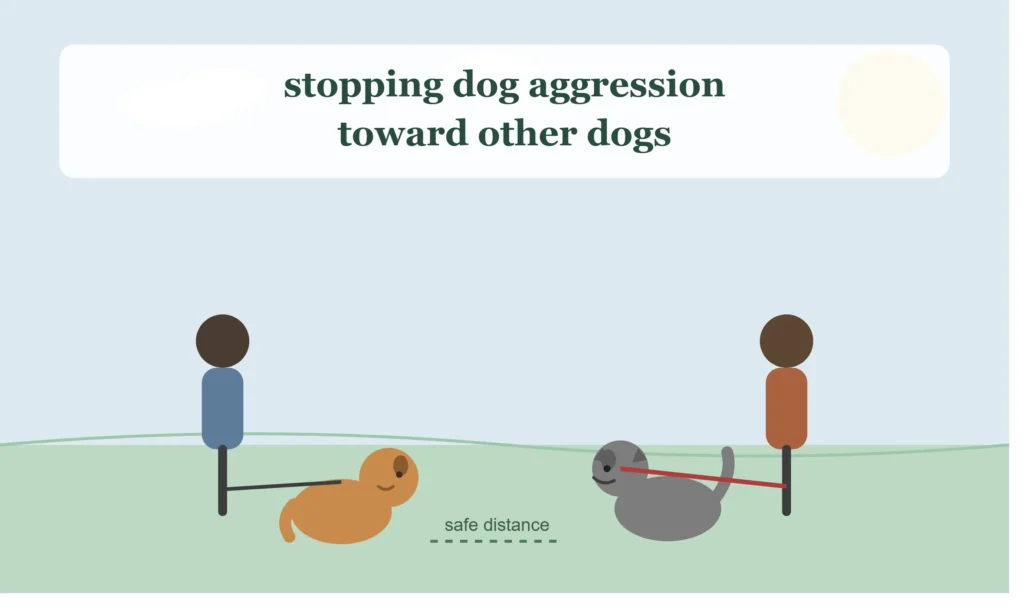
Step 2: Find Your Dog’s “Threshold Distance”
Every reactive dog has a distance at which they notice another dog but can still stay calm and responsive to you — this is called the threshold. Find that distance (it might be 30 feet, it might be 100) and start all training there.
Step 3: Use Counter-Conditioning and Desensitization
This is the gold-standard, science-backed method used by professional trainers and veterinary behaviorists.
- When your dog notices another dog at a safe distance, immediately mark the moment (with a clicker or the word “yes”) and reward with a high-value treat — think small pieces of chicken, cheese, or freeze-dried liver, not regular kibble.
- Repeat this every time another dog appears, so your dog starts associating “other dog = amazing treats” instead of “other dog = threat.”
- Gradually decrease the distance over multiple sessions, only moving closer once your dog is reliably calm at the current distance.
- If your dog reacts (barking, lunging, growling), you’ve moved too fast — increase distance immediately and rebuild from there.
Step 4: Teach an “Engage-Disengage” or “Look at Me” Cue
Train a strong, reliable cue that gets your dog to look at you on command, practiced first at home with zero distractions, then gradually in the presence of distant dogs. This gives your dog an alternative behavior to fall back on instead of reacting.
Step 5: Practice Controlled Structured Walks
Once your dog is more responsive, try structured “parallel walks” with a calm, known dog — both dogs walking in the same direction at a distance, gradually closing the gap over several sessions if both remain relaxed. This should ideally be done alongside a professional trainer the first few times.
Step 6: Never Punish the Growl
It’s tempting to correct growling or barking harshly, but punishing the warning signal often just removes the warning — not the underlying aggression — leaving you with a dog who bites without notice. Address the emotion behind the behavior, not just the symptom.
Tools and Products That Can Help
- Front-clip harnesses (like a Y-shaped, no-pull design) for better leash control without choking
- High-value treat pouches for quick access during training walks
- Long training leads (15–30 ft) for practicing distance work in open spaces
- Calming aids such as pressure wraps (e.g., anxiety-reducing vests) — check with your vet before trying supplements or calming chews
- Visual “give me space” vests or leash sleeves (often yellow, labeled “in training” or “do not approach”) to warn other dog owners to keep distance
When to Call in a Professional
If your dog’s aggression involves biting, drawing blood, or escalating despite consistent training, it’s time to work with a certified professional dog trainer (look for credentials like CPDT-KA) or a veterinary behaviorist. Severe or sudden aggression should always be evaluated by your veterinarian first to rule out pain or medical causes, since no amount of training addresses a physical root problem. A professional can also design a customized behavior modification plan and, in some cases, discuss whether anti-anxiety medication might support the training process.
Final Thoughts
Dog-to-dog aggression can feel isolating and stressful, but it’s a well-understood behavior challenge with a clear, proven path forward. Start by managing your dog’s environment to prevent rehearsal of the behavior, learn to read the early warning signs, and use structured counter-conditioning at a distance your dog can handle. Progress takes patience, but with consistency — and professional support when needed — most dogs can learn to feel safe and calm around other dogs again.
If your dog’s aggression is severe, sudden, or involves biting, please consult a licensed veterinarian or a certified professional trainer for a tailored evaluation and plan.
Read This
Teaching a Dog to Walk Off Leash: The Complete Guide
FAQS:
Can dog-to-dog aggression be completely cured?
Most dogs show major improvement with consistent training, though “cured” isn’t always realistic — the goal is usually manageable, calm behavior rather than total elimination of all reactivity.
My dog is fine at home but aggressive on walks — why?
This is classic leash reactivity, caused by restricted movement and limited escape options; it’s different from generalized aggression and typically responds well to counter-conditioning.
Is it okay to force my dog to “meet” another dog to get over their fear?
No — forced greetings often backfire and increase fear or aggression. Progress should always happen at a distance your dog can handle calmly.
Should I use a shock collar or prong collar to stop the reaction?
Aversive tools can suppress the visible behavior short-term but often increase underlying anxiety and aggression long-term; positive reinforcement methods are widely recommended by veterinary behavior professionals.
How long does it typically take to see improvement?
Many owners notice small changes within a few weeks of consistent practice, though full behavior change can take several months depending on the dog’s history and severity.
- Why Every Pet Owner Needs an Emergency Pet First Aid Kit
- Affordable Pet Care on a Budget: A Real Owner’s Guide
- Moving House With a Cat: Tips to Keep Your Feline Calm and Safe
- Flea and Tick Prevention Guide: How to Protect Your Pet Year-Round
- How to Pet Proof a Christmas Tree: A Complete Guide for Dog and Cat Owners