
Every new puppy owner asks the same question: when can puppies go outside safely? The short answer is that your puppy can go outside in your own yard from the day you bring it home, but public places like dog parks, pet stores, and busy sidewalks should wait until about one week after the final round of puppy vaccinations, usually around 16 weeks of age. That gap between “your yard” and “the world” confuses a lot of owners, and the confusion matters, because the diseases that threaten unvaccinated puppies are serious. This guide explains the vet-approved timeline, what counts as safe versus risky, how to socialize your puppy before vaccinations are complete, and how to handle potty training while you wait.
The reason for the wait is immunity. Puppies get some protection from their mother’s milk, but that protection fades between six and sixteen weeks of age. Vaccines fill the gap, but they only work after a series of shots given a few weeks apart. Until that series is complete, your puppy has a window of vulnerability to diseases like parvovirus, distemper, and leptospirosis. Parvovirus is the big one: it survives in soil for months or even years, it is spread through infected feces, and it kills a significant share of unvaccinated puppies that catch it. The risk is real, but it is also manageable. You do not need to keep your puppy locked indoors for four months. You need to choose where its paws go.
The Vaccination Timeline That Decides When Can Puppies Go Outside
Most US veterinarians follow a schedule similar to the one recommended by the American Animal Hospital Association. Puppies typically receive their first round of core vaccines at six to eight weeks of age, a second round at ten to twelve weeks, and a third round at fourteen to sixteen weeks. The core vaccines are distemper, adenovirus, parvovirus, and rabies, with rabies usually given once between twelve and sixteen weeks depending on your state’s law. Your vet may also recommend non-core vaccines such as Bordetella, leptospirosis, and canine influenza based on where you live and your puppy’s lifestyle.
Your puppy is not considered fully protected until about seven to ten days after the final round, which is usually the sixteen-week visit. That is the moment your vet will typically give you the green light for dog parks, pet stores, group training classes, and busy public sidewalks. Before that point, your puppy has partial protection that grows stronger with each round, but partial is not full. Think of it like a raincoat that gets a little longer with each visit: after the second round your puppy has decent coverage, but the third round is what finishes the job. Always confirm the exact timing with your own vet, because local disease risk varies. In areas with a parvo outbreak, your vet may advise extra caution, while in low-risk areas they may clear your puppy for more outings a little sooner. For what happens at those early vet visits, see our guide to your puppy’s first vet visit.
Where Your Puppy CAN Go Before Vaccinations Are Complete
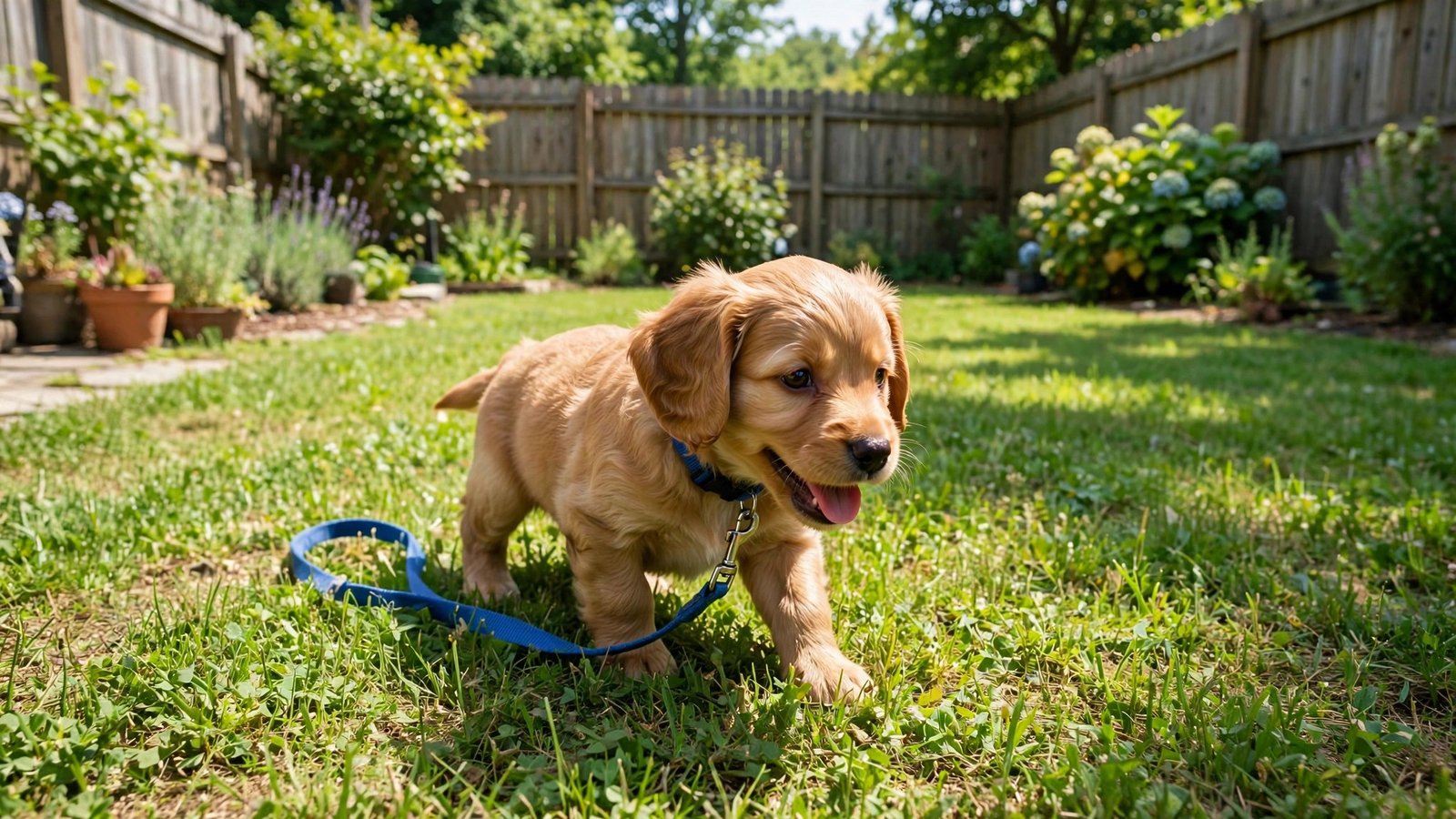
Your own yard is the safest outdoor space for a young puppy, provided no unknown or unvaccinated dogs use it and you clean up feces promptly. Puppies need to go outside for potty training from day one, and there is no way around that. A private yard, a balcony with a potty pad, or a clean patch of grass that only your household dogs use are all fine. If you live in an apartment and your only option is a shared courtyard or a busy sidewalk, carry your puppy to a spot that other dogs do not use, let it do its business, and carry it back inside. Your puppy’s paws do not need to touch the ground for a potty break to count.
Your puppy can also go outside in your arms, in a carrier, or in a stroller. This is one of the best-kept secrets of puppy raising. Carried outings let your puppy see the world, hear traffic, meet people, and watch other dogs from a safe distance, all without any disease risk from the ground. Take your puppy to a farmers market in a carrier, sit on a park bench with it on your lap, or drive to a busy street and let it watch the world from the car window. These experiences count as socialization, and the socialization window closes around fourteen weeks, so you cannot afford to wait until vaccinations are done to start.
Visits to the homes of friends and family are usually fine too, as long as their dogs are healthy and fully vaccinated and their yard is clean. Puppy playdates with known, vaccinated adult dogs are excellent for teaching bite inhibition and dog manners. Just avoid homes with unvaccinated dogs or puppies of unknown health status, and skip any yard where stray dogs roam.
Where Your Puppy Should NOT Go Yet
Some places are high risk for an unvaccinated puppy, and they are worth avoiding until your vet clears your puppy. Dog parks top the list, because the ground is shared by dozens of unknown dogs and parvo can persist in the soil for a year or more. Pet stores are another risk, since many dogs pass through and puppies are often put down on the floor. Busy sidewalks, rest stops, highway rest areas, and apartment dog runs are also high traffic. Anywhere with standing water or puddles is a leptospirosis risk, since the bacteria spread through water contaminated with animal urine. Dog beaches, hiking trails used by many dogs, and training classes held on shared ground should wait too. None of this is forever, it is a few weeks of caution that protects a puppy with an immature immune system. The American Kennel Club’s guidance on when puppies can safely go outside covers the same risk categories and is worth a read.
Be especially careful with areas where puppies from unknown backgrounds gather, such as the sidewalk outside a shelter, a rescue event, or a pet store adoption day. These are wonderful places, but not for a puppy that has only had one round of shots. If you must pass through a high-traffic area with your puppy, carry it. Its paws never touching the ground removes almost all of the disease risk.
How to Socialize Your Puppy Safely Before 16 Weeks
Here is the tension every owner faces: the socialization window closes at about fourteen weeks, but full vaccination protection does not arrive until about sixteen weeks. Vets and behaviorists agree that the answer is safe socialization, not no socialization. A puppy that is kept indoors until sixteen weeks often grows into a fearful adult dog that is scared of strangers, traffic, and other dogs. That fear causes far more problems over a dog’s lifetime than the small, managed disease risk of careful early outings.
Safe socialization means controlled exposure. Invite friends of all ages to your home, including people wearing hats, people with beards, and children who know how to be gentle. Play recordings of thunderstorms, fireworks, vacuum cleaners, and traffic at low volume while your puppy eats. Let your puppy meet calm, vaccinated adult dogs in your home or yard. Take your puppy on carried outings to new places three or four times a week: a hardware store parking lot, a quiet cafe patio, a friend’s backyard. Let people offer your puppy treats so it learns that strangers are good news. Our guide on how to socialize a puppy has a week-by-week checklist of sights, sounds, and experiences to cover before the window closes.
Puppy kindergarten classes run by your vet clinic or a certified trainer are usually safe even before the final round of shots, because the facility is cleaned, all puppies must show proof of at least their first vaccinations, and the trainer controls the environment. Ask the trainer about their cleaning protocol and vaccine requirements before signing up. If a class lets any dog walk in off the street with no vaccine check, skip it.
Potty Training While You Wait
Potty training does not pause for vaccinations. From the first day home, take your puppy to the same outdoor spot after every meal, after every nap, after every play session, and every two hours in between. In an apartment, that means carrying your puppy downstairs to a low-traffic patch of grass. Use a consistent phrase like “go potty” and reward immediately with a treat the moment your puppy finishes. If you live somewhere with no private outdoor space at all, indoor grass pads or a litter box setup can bridge the gap until your puppy is cleared for public sidewalks. Our guide on how to potty train a puppy covers the full schedule, accident cleanup, and the signals that your puppy needs to go right now.
Nighttime is the hardest part. A puppy under twelve weeks will need one or two nighttime potty breaks, and you will need to carry it outside in the dark. Keep a leash, shoes, and a flashlight by the door so you can get out and back in under five minutes. Keep it boring: no play, no conversation, straight back to the crate. For help settling your puppy back to sleep after those wake-ups, see our guide to crate training a puppy, which covers setting up a calm sleep routine.
First Walks: How to Start Once Your Vet Gives the All-Clear
When your vet says your puppy is ready, start small. The first walks should be five to ten minutes on a quiet street, on a leash, with a properly fitted harness. Puppies under four months should not do long walks or forced exercise, because their growth plates are still open and too much impact can cause joint problems later. A good rule is five minutes of walking per month of age, twice a day, so a four-month-old puppy gets about twenty minutes per walk. Let your puppy sniff. Sniffing is mental exercise, and a walk that is mostly sniffing tires a puppy out more than a fast march around the block.
Introduce the leash indoors first. Let your puppy wear the harness around the house for a few minutes at a time, then attach the leash and let it drag it around under supervision. Practice walking together in your yard before you hit the sidewalk. Bring treats and reward your puppy for walking beside you. If your puppy freezes, sits down, or pulls toward every smell, that is normal. Be patient, keep the sessions short, and end on a good note. Avoid retractable leashes, which give you little control and teach pulling, and avoid busy roads, hot pavement, and off-leash areas until your puppy has reliable recall.
Weather and Safety for Young Puppies Outdoors
Young puppies cannot regulate their body temperature well, so weather matters. In summer, walk only in the early morning or evening, test pavement with the back of your hand, and carry water. If the pavement is too hot for your hand after five seconds, it is too hot for puppy paws. In winter, keep outings short, watch for shivering, and wipe paws after walks to remove road salt, which irritates skin and is toxic if licked. Puppies with short coats or small bodies get cold fast, and a puppy jacket is a reasonable purchase for winter walks. Never leave a puppy in a parked car, even for a few minutes, and never leave a young puppy unsupervised in a yard. Puppies dig under fences, chew things they should not, and can be targeted by hawks, coyotes, or stray dogs depending on where you live.
What If Your Puppy Misses a Vaccine or Gets Sick?
If you miss a vaccine appointment by a few days, call your vet and reschedule as soon as possible. A short delay is not a disaster, but do not skip a round or stretch the gap to months, because the series is designed so each shot builds on the last. If your puppy develops diarrhea, vomiting, lethargy, or a loss of appetite after an outing, call your vet the same day. Parvo’s early signs look like an ordinary upset stomach, and early treatment makes a huge difference in survival. Keep your vet’s phone number and the nearest emergency vet clinic saved in your phone before you need them. If your puppy was exposed to a known sick dog or a high-risk area, tell your vet exactly what happened so they can advise whether testing or monitoring is needed.
When Can Puppies Go Outside to Dog Parks, Beaches, and Daycare?
Dog parks, dog beaches, and doggy daycare are the highest-risk public spaces, so they should wait until at least one week after the final vaccination round, and your vet may advise waiting until eighteen weeks in high-risk areas. When you do go, choose your first visits carefully. Go during off-peak hours when the park is quiet, keep your puppy on a leash at first, and watch how it interacts with other dogs. Leave immediately if the play gets rough, if large dogs are bullying small ones, or if the park looks dirty or has standing water. A good dog park has separate areas for small and large dogs, clean water, and owners who watch their dogs. A bad one has none of those things, and no amount of vaccination makes a bad park safe.
Doggy daycare is a similar calculation. A reputable daycare will require proof of full vaccination, including Bordetella, and will do a temperament test before accepting your puppy. That screening is a good sign. A daycare that accepts any dog with no questions asked is a red flag. Ask about their cleaning routine, staff-to-dog ratio, and what happens if a dog gets sick. The best daycares separate puppies from adult dogs and give young dogs rest breaks, because overtired puppies get cranky and snappy just like overtired toddlers.
Pet stores, outdoor restaurants, and hiking trails fall in the middle. Once your vet clears your puppy, these are all fine with normal precautions. Keep your puppy on a leash, do not let it drink from communal water bowls, and do not let it eat things off the ground. On hiking trails, watch for ticks, foxtails, and wild animal feces, and check your puppy over when you get home. Tick prevention should be part of your puppy’s regular care, and your vet can recommend a product that is safe for your puppy’s age and weight.
The Bottom Line
So, when can puppies go outside? Your own yard from day one, carried outings and visits to vaccinated friends’ homes from the first week, and the wider public world about a week after the final round of puppy shots, usually around 16 to 17 weeks of age. The goal is not to lock your puppy indoors for four months. It is to give your puppy the world in safe doses: potty breaks in your yard, socialization from your arms and in clean, controlled settings, and real walks and dog parks once the vaccines have done their job. Follow your vet’s advice for your area, keep the vaccine schedule on track, and use the waiting period to socialize smartly. Your puppy will end up confident, well-adjusted, and healthy, which is exactly the point.
Frequently Asked Questions
When can puppies go outside for the first time?
Your puppy can go outside in your own private yard from the day you bring it home, for potty breaks and play. Public places with unknown dogs should wait until about one week after the final vaccination round, usually around 16 weeks of age.
Can I take my 8-week-old puppy outside to pee?
Yes. Puppies must go outside to pee from day one. Use your own yard or a clean spot other dogs do not use, and carry your puppy through shared hallways or busy sidewalks to that spot.
Can I take my puppy to a dog park before vaccinations are finished?
No. Dog parks are high risk for parvovirus, which survives in soil for months. Wait until at least one week after the final round of puppy vaccines, and check with your vet first.
How can I socialize my puppy before it is fully vaccinated?
Carry your puppy on outings, invite visitors to your home, arrange playdates with healthy vaccinated dogs, and attend a puppy class at a vet clinic or with a certified trainer that checks vaccine records.
What happens if my puppy misses a vaccine appointment?
Call your vet and reschedule as soon as you can. A delay of a few days is not a disaster, but do not skip a round. The vaccine series works because each shot builds on the one before it.