
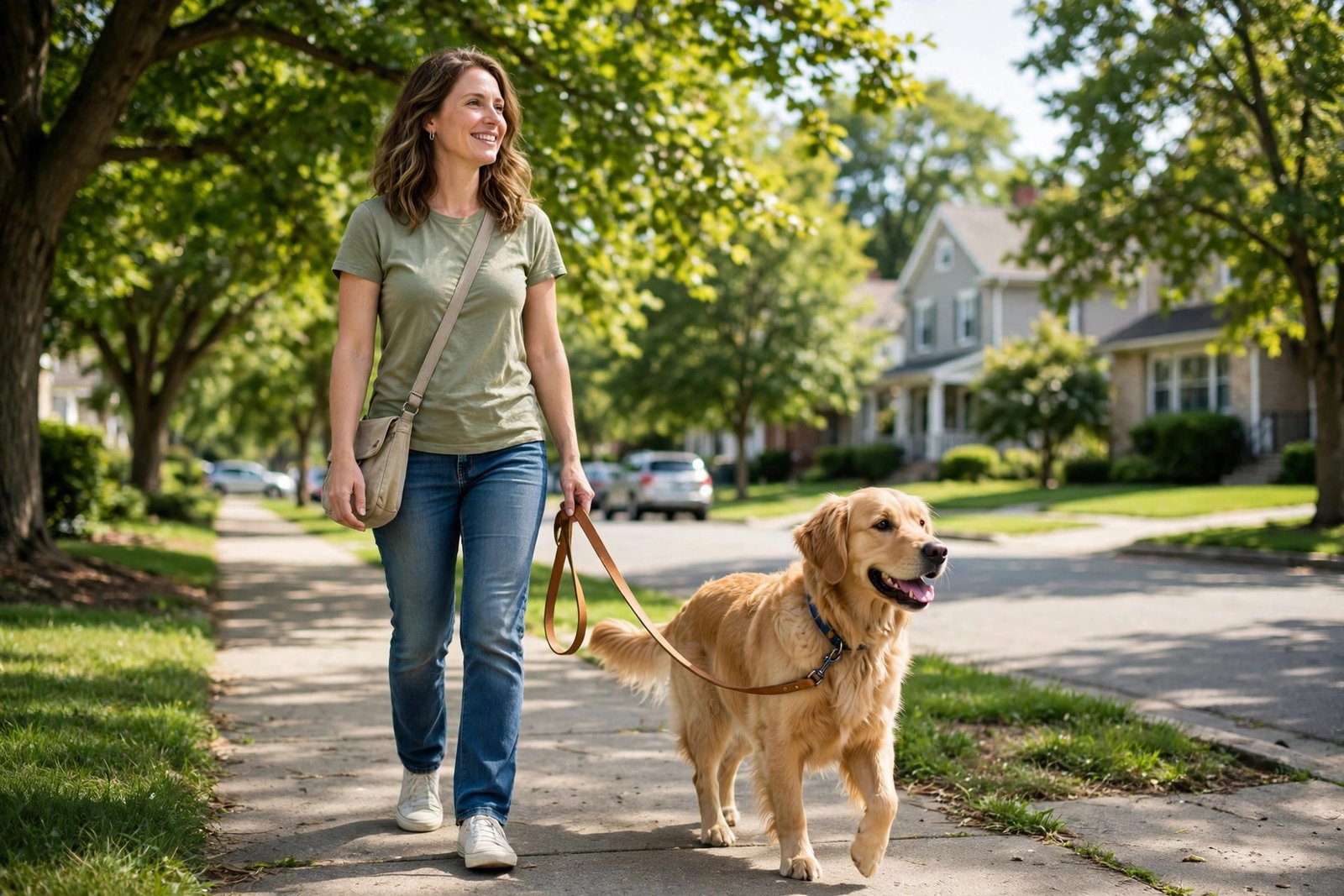
Learning how to stop dog pulling on leash is one of the most useful things you will ever teach your dog — and one of the most frustrating to learn. A dog that pulls turns every walk into a tug-of-war: sore shoulders, tangled leashes, and a walk that feels like a chore instead of the best part of the day. The good news is that pulling is fixable. It is not a personality flaw, it is not dominance, and it is not because your dog is stubborn. Pulling happens because it works. Every time your dog pulls forward and gets to the interesting smell, the other dog, or the park, pulling is rewarded. The fix is to make loose-leash walking more rewarding than pulling — and that is a skill any owner can teach.
Loose-leash walking means your dog walks beside you with slack in the leash, checking in with you, and matching your pace. It is not a formal heel — your dog does not need to march at your knee staring up at you. It is simply a relaxed walk where the leash hangs in a loose “J” shape and nobody is being dragged. Most dogs can learn this in a few weeks of consistent practice, and even chronic pullers can improve dramatically. This guide covers the exact method, the gear that helps, the mistakes that slow you down, and how to handle the situations that trigger the worst pulling.
Why Do Dogs Pull on the Leash?
Before fixing pulling, it helps to understand why it happens. Dogs pull for a few simple reasons, and none of them involve spite.
Pulling gets them where they want to go. This is the big one. A dog pulls toward a smell, and they arrive at the smell faster. The behavior is rewarded every single time it works, which means it gets stronger every single walk. This is why pulling is so common: owners accidentally train it by following the dog wherever the dog drags them.
Walking is exciting. The outdoors is a buffet of smells, sights, and sounds. For many dogs, especially young ones, the excitement of the walk overwhelms their self-control. They are not trying to be difficult — they are overstimulated and have not yet learned to manage that excitement.
They have never been taught otherwise. Most owners put a leash on a puppy, walk out the door, and hope for the best. The puppy pulls, the owner follows, and a habit is born within a week. Loose-leash walking is a trained skill, not something dogs do naturally.
Breed and energy play a role. High-energy breeds — Huskies, Labradors, Boxers, German Shepherds — pull harder and more often, especially if they are under-exercised. A dog with unspent energy will always pull more than a dog that has already had a good run or play session.
How to Stop Dog Pulling on Leash: The 7-Step Method
Step 1: Get the Right Gear
You do not need special equipment to teach loose-leash walking, but the right gear makes it easier. A standard 6-foot leash is ideal — retractable leashes teach pulling, because they reward the dog for moving away from you with more freedom, so retire yours. A front-clip harness is the single most helpful tool for most pullers: when the dog pulls, the front clip gently turns them back toward you instead of letting them lean into the pressure. Front-clip harnesses cost $20 to $40 and work well for most medium and large dogs.
Avoid choke chains and prong collars. They can suppress pulling through pain, but they do not teach the dog anything, they risk injury to the neck and trachea, and they can make leash reactivity worse. The ASPCA recommends positive, reward-based methods for leash training, and the evidence supports it: dogs trained with rewards learn faster and retain the behavior better.
Stock up on high-value treats before you start — small, soft, smelly ones your dog loves, like tiny pieces of cheese, hot dog, or commercial training treats. You will need a lot of them. A treat pouch that clips to your waist ($10 to $15) keeps your hands free and your treats accessible. For ideas on what to use, see our guide to the best treats for training dogs.
Step 2: Start Indoors, Where It Is Boring
Do not start loose-leash training on a busy sidewalk. Start in your living room or hallway, where there are no squirrels, no other dogs, and no exciting smells. Clip the leash on, hold a treat at your side, and take a few steps. Every time your dog is beside you with a loose leash, mark it with a cheerful “yes!” and deliver a treat. If your dog surges ahead, stop and wait. The moment the leash goes slack — even for a second — mark and reward.
Practice for 5 minutes at a time, two or three times a day. Keep it fun and keep the rewards flowing. Your dog should think that walking beside you is the best deal in the world. Once your dog can walk nicely around the house, move to the backyard, then the driveway, then a quiet street. Increase the difficulty gradually. If your dog falls apart at a new level, go back a step — that is not failure, it is training.
Step 3: Be a Tree
The “be a tree” method is the foundation of loose-leash training, and it is beautifully simple: when the leash goes tight, you stop moving. You become a tree. You do not yank, you do not scold, you do not drag your dog back — you just stop. You wait. The moment your dog turns, steps back, or otherwise creates slack in the leash, you mark it (“yes!”) and start walking again.
The logic is airtight. Pulling used to make the walk continue. Now pulling makes the walk stop. Loose leash makes the walk continue. Dogs figure this out fast — usually within a few sessions — as long as you are consistent. The catch is that you must stop every single time the leash goes tight, even when you are in a hurry, even when it is raining, even when your dog is lunging at a squirrel. One time you let the dog drag you forward to the exciting thing, you have rewarded the pulling and set the training back.
Step 4: Reward the Position You Want
Stopping when the leash is tight teaches your dog what not to do. Rewarding the right position teaches them what to do. These two halves work together. While you walk, deliver a treat every few steps when your dog is in the right spot — beside you, leash loose. At first, reward every 3 to 5 steps. As your dog improves, stretch it to every 10 steps, then every 20, then randomly. The goal is a dog that walks beside you because that position has a long history of paying off.
Use a marker word (“yes!”) or a clicker the instant your dog is in the right spot, then deliver the treat at your side — not out in front of you, which would pull your dog forward. Treat delivery location matters: treats delivered at your left leg teach your dog to stay at your left leg. This is the core of the whole method, and it is worth getting right.
Step 5: Change Direction
When your dog pulls hard and “being a tree” is not working — for example, when they are fixated on something ahead — change direction. Turn around calmly and walk the other way. Your dog will follow, the leash will go slack, and you can reward them for catching up and walking with you. Change direction again when they pull again. You will look slightly ridiculous, walking back and forth on the same stretch of sidewalk, and it works brilliantly.
Direction changes teach your dog to pay attention to you, because you might go anywhere at any time. A dog that watches you is a dog that does not pull. Use this technique sparingly — a few direction changes per walk is plenty — and combine it with rewards for walking nicely.
Step 6: Add Distractions Gradually
Once your dog walks nicely on a quiet street, it is time to add distractions — one at a time. A quiet park before a busy one. A distant dog before a close one. A squirrel across the street before a squirrel on the sidewalk. The rule is simple: if your dog can still think and respond to you, the distraction level is right. If your dog cannot hear you, cannot take a treat, and is pulling like a freight train, the distraction is too much. Create distance, let your dog calm down, and try again from farther away.
For dogs that pull specifically toward other dogs, work on this at a distance where your dog notices the other dog but can still respond to you. Reward calm looking, then turn away. Over time, decrease the distance. This is the same gradual approach used for reactivity, and it works — our article on stopping barking at strangers covers the same desensitization principles in more detail.
Step 7: Make Walks Worth the Wait
Here is the part most owners skip: before the walk even starts, burn off some energy. A dog that has just played fetch in the yard for 10 minutes, or done a short training session, will walk far more calmly than a dog that has been cooped up all day and is bursting with energy. If your dog pulls worst at the start of the walk and settles down after 10 minutes, that is a clear sign they need a pre-walk outlet.
Also, give your dog sniffing time. A walk is not just exercise — it is your dog’s newspaper, social media, and entertainment all in one. Build in “sniff breaks” where you stop and let your dog investigate a patch of grass. Dogs that get to sniff are calmer, happier, and less frantic on the leash. A walk with sniff breaks is a better walk, not a wasted one.
Common Mistakes That Keep the Pulling Going
Using a retractable leash. Retractable leashes teach dogs that pulling earns more leash and more freedom. They also make it nearly impossible to teach a consistent loose-leash position. Switch to a 6-foot flat leash and you will see improvement within days.
Letting the dog pull “just this once.” Inconsistency is the number one reason leash training fails. If pulling works sometimes, your dog will keep trying it — that is how variable reinforcement works, and it is the same principle that makes slot machines addictive. Pick a rule and stick to it on every walk.
Yanking the leash. Yanking hurts, startles, and teaches nothing. It can also injure your dog’s neck. If you need to get your dog’s attention, use your voice or a treat, not a leash pop.
Training sessions that are too long. Five focused minutes beats 30 frustrated minutes. End on a success, while your dog is still engaged, and try again later.
Skipping the rewards. Some owners stop rewarding once the dog improves, and the behavior fades. Keep rewarding loose-leash walking intermittently for months — a treat every so often keeps the behavior strong for life.
What About Puppies?
Puppies pull just like adult dogs, and the same method works — with shorter sessions and lower expectations. A puppy’s attention span is measured in minutes, so train in 3-to-5-minute bursts and celebrate small wins. Start leash training the day your puppy comes home, using a lightweight leash and a harness, and practice indoors first. Puppies that learn loose-leash walking early never develop a pulling habit in the first place, which is far easier than fixing one later.
If your puppy is pulling on every walk and you are also working on other basics, our guide to dog leash training covers the full foundation — introducing the leash, getting your puppy comfortable with the harness, and building up to real walks step by step.
When to Get Professional Help
Most pulling is fixable at home with consistency. But if your dog is large, strong, and you physically cannot hold them, or if the pulling is paired with lunging, barking, and aggression toward other dogs or people, get professional help. A certified professional dog trainer (look for CPDT-KA credentials) can assess your dog in person and build a plan. Group obedience classes are also excellent — a basic 6-week group class typically costs $100 to $200 in the United States and gives you structured practice around distractions, which is exactly what most pullers need. Private sessions cost more, usually $50 to $100 per hour, but they are worth it for serious cases.
If pulling is paired with anxiety — for example, your dog pulls frantically to get home, pants heavily, and seems distressed rather than excited — talk to your vet. Anxiety can drive pulling, and in some cases behavior modification plus medication is the right call. Our guide to dog separation anxiety solutions covers the basics of anxiety management if that sounds familiar.
How Long Does It Take?
With daily practice, most dogs show clear improvement within 1 to 2 weeks, and reliable loose-leash walking within 4 to 6 weeks. Older dogs with years of pulling history may take longer — 2 to 3 months is normal, and that is fine. The key is consistency: every walk is a training walk, every tight leash means a stop, and every loose leash earns a reward. Progress is rarely a straight line. Your dog will be brilliant on Tuesday and terrible on Wednesday, and that is normal learning. Keep going.
A realistic expectation: your dog will not walk perfectly on every walk, forever. There will be squirrels. There will be days when the excitement wins. The goal is not perfection — it is a walk that is enjoyable for both of you most of the time. That is absolutely achievable.
The Bottom Line
How to stop dog pulling on leash comes down to one principle: make loose-leash walking pay and make pulling fail. Stop when the leash goes tight, reward generously when it stays loose, practice in easy places before hard ones, and be consistent on every single walk. Get a front-clip harness and a 6-foot leash, ditch the retractable, and give your dog the exercise and sniffing time they need. Most dogs improve dramatically within a few weeks, and the walks you both actually enjoy are worth every minute of training.
Frequently Asked Questions
How do I stop my dog from pulling on the leash immediately?
There is no instant fix, but the fastest improvement comes from stopping the moment the leash goes tight (“be a tree”) and using a front-clip harness, which physically reduces pulling power. Most owners see a difference within a few days of consistent stopping and rewarding.
Does a harness stop a dog from pulling?
A front-clip harness reduces pulling significantly because it turns the dog toward you when they pull, but it does not train the dog on its own. Combine the harness with reward-based loose-leash training for lasting results. A back-clip harness can actually make pulling worse by giving the dog something to lean into.
Why does my dog pull only at the start of the walk?
Most dogs pull hardest at the start because they are full of energy and excitement. A 10-minute play or training session before the walk, plus a few sniff breaks early on, usually solves it. The pulling typically fades as the walk goes on and energy drops.
Should I use a prong collar to stop pulling?
Positive trainers and veterinary behaviorists recommend against prong and choke collars — they suppress behavior through pain, risk neck injury, and can increase fear and reactivity. Reward-based loose-leash training with a front-clip harness is safer and produces more reliable long-term results.
How long does it take to train a dog not to pull?
Most dogs improve noticeably within 1 to 2 weeks of daily practice and walk reliably on a loose leash within 4 to 6 weeks. Dogs with years of pulling history may take 2 to 3 months. Consistency on every walk matters more than the total number of training sessions.