
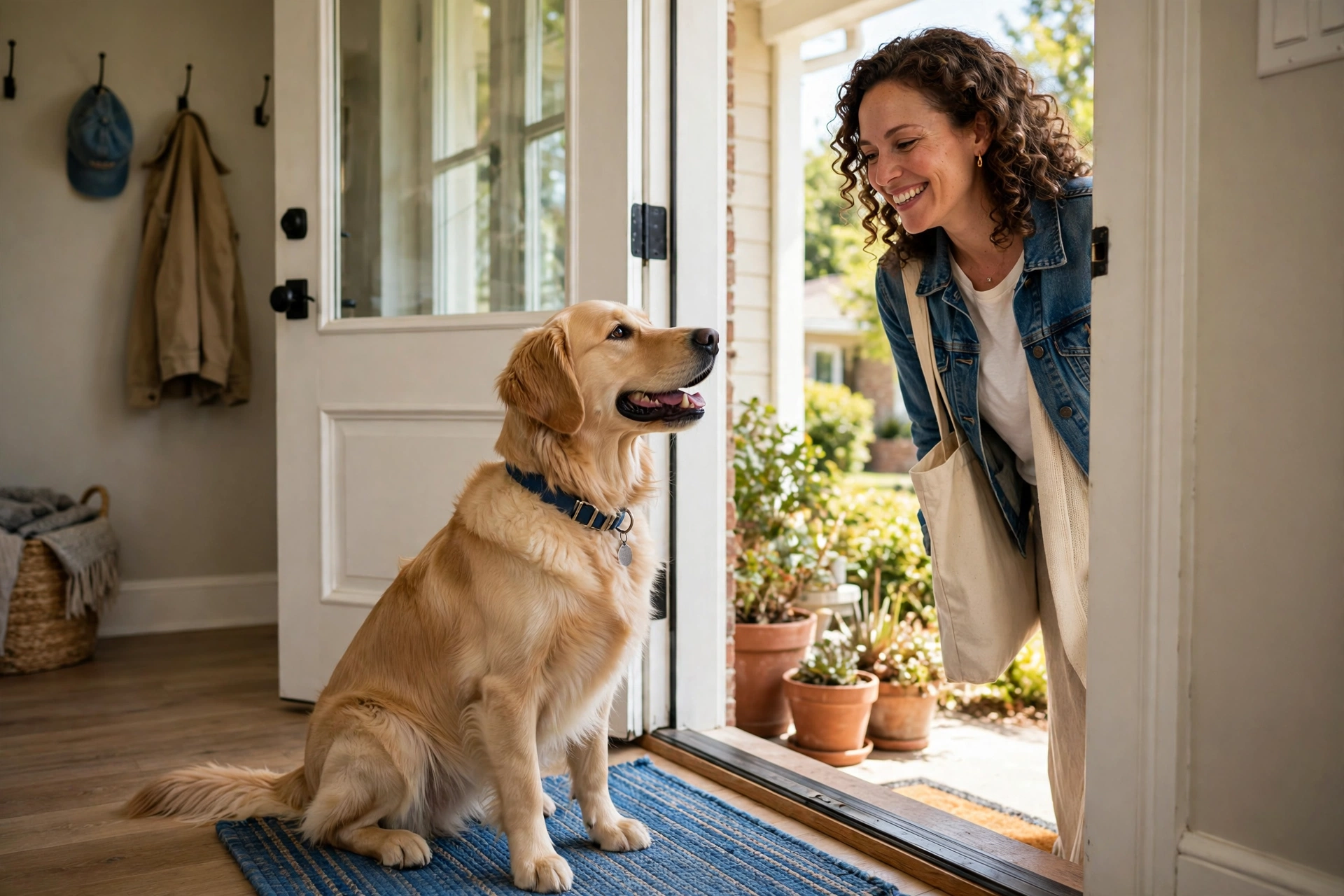
Your dog is not being rude when he jumps on people. He is being a dog. Jumping is one of the most natural greeting behaviors in the canine world. Dogs greet each other face to face, and when they meet a person, the fastest way to reach that face is to jump up. It feels good, it gets attention, and it has probably worked many times before. That is exactly why it is so common — and why it can be fixed.
A jumping dog is more than an annoyance. A big dog can knock over a child, scratch a guest’s legs, muddy a visitor’s clothes, or send an elderly relative stumbling. Even a small dog can startle someone who is afraid of dogs or unsteady on their feet. The good news is that jumping is one of the most trainable behaviors there is. You do not need harsh corrections, special equipment, or a perfect dog. You need a clear rule, a replacement behavior your dog can do instead, and enough repetition for the new habit to stick.
This guide walks you through the method professional trainers use most often: teach your dog that four paws on the floor earns attention, and jumping earns nothing. It works for puppies, adult dogs, and rescue dogs who have been jumping for years. It takes patience and consistency, but most owners see real improvement within a few weeks when everyone in the household follows the same plan.
Why Dogs Jump on People
Jumping is not dominance, spite, or a sign that your dog does not respect you. It is almost always one of three things: greeting, excitement, or attention-seeking. Understanding which one is driving your dog helps you fix it faster.
It is a greeting
When two dogs meet, they approach each other face to face and sniff. A dog meeting a person wants to do the same thing, but human faces are far above a dog’s nose. Jumping is simply the shortest route. This is why jumping is worst at the front door and when you come home after being away. Your dog is genuinely happy to see you, and jumping is how that excitement comes out.
It is excitement
Some dogs jump more when they are overstimulated: visitors arriving, children running around, the leash coming out, or a favorite person walking through the door. Excitement lowers impulse control, especially in young dogs and high-energy breeds. The more exciting the moment, the harder it is for your dog to think. That is why training has to start in calm moments and only gradually move to exciting ones.
It has been rewarded
This is the biggest reason jumping continues. Every time a person laughs, talks to the dog, pushes him down, pets him, or even looks at him while he is jumping, the dog learns that jumping works. Attention is attention, even when it is negative attention. If jumping got your dog petted even once out of every few tries, that is enough to keep the behavior going. Dogs repeat whatever has paid off before, and jumping has a long history of paying off.
Why Ignoring Alone Usually Fails
You have probably heard the advice to just turn your back and ignore a jumping dog. It is a reasonable starting point, but on its own it rarely solves the problem. There are a few reasons why.
First, ignoring only works if everyone ignores the jumping, every single time. In real life, that almost never happens. One guest bends down to pet the dog, one child squeals and pushes him away, one family member laughs — and the dog just learned that jumping sometimes works. Intermittent rewards are actually the strongest kind. A slot machine pays out rarely, and that is exactly why people keep pulling the lever. A dog who gets attention for jumping once in a while will keep trying far longer than a dog who gets attention every time.
Second, ignoring tells your dog what not to do, but it does not tell him what to do instead. A dog who wants to greet you still needs a way to greet you. If you give him no alternative, he will keep offering the only greeting he knows. Effective training always pairs removing the reward for the unwanted behavior with rewarding a better behavior in its place.
Third, some dogs find the act of jumping rewarding in itself. The physical sensation, the excitement, and the closeness to a person’s face can be enough of a payoff even without petting. For these dogs, standing still and waiting it out is not enough. You need to actively teach and reward a calm greeting.
Ignoring is still part of the plan — you should absolutely stop giving attention for jumping. But it has to be combined with teaching a replacement behavior and managing the environment so your dog can succeed.
The Four-on-the-Floor Rule
Every successful jumping program is built on one simple rule: all four paws on the floor earns attention, and jumping earns nothing. This is the foundation everything else rests on, so get the whole household to agree on it before you start.
The rule works like this. When your dog’s paws are on the floor, he gets what he wants: your attention, petting, treats, and greetings. The moment his front paws leave the floor, all of that stops. You turn away, fold your arms, look at the ceiling, and become the most boring person in the room. No talking, no eye contact, no pushing him down. Pushing is still attention, and it can feel like a game to a dog.
As soon as all four paws are back on the floor, even for a second, you calmly reward him. A quiet “good” and a treat delivered low, near the floor, works well. Delivering the treat low matters: if you hold the treat up high, you are inviting your dog to jump for it. Keep treats at his nose level or below so staying down is the easy choice.
Start practicing this in calm, low-excitement moments, not at the front door with guests arriving. Walk into a room, and if your dog stays down, reward him. If he jumps, turn away and wait. The first few sessions can feel slow, and your dog may jump more at first — a normal response called an extinction burst, where a behavior gets worse briefly when it stops working. Stay calm and consistent. The burst passes, and most dogs start offering four-on-the-floor behavior within a few short sessions once they realize it is the only thing that works.
For this to work you need treats your dog genuinely loves, because you are asking him to give up something exciting. Small, soft treats he can eat quickly are ideal for training, so you can reward often without filling him up. If you are not sure what to use, our guide to the best treats for training dogs covers how to pick high-value rewards your dog will actually work for.
Teach Sit-to-Greet: The Replacement Behavior
Four-on-the-floor is the rule, but sit-to-greet is the skill that makes the rule easy for your dog to follow. A dog who is sitting cannot be jumping at the same time. If sitting becomes his default greeting, the jumping problem largely solves itself.
Step 1: Teach a solid sit
If your dog does not already sit reliably on cue, teach that first in a quiet room with no distractions. Hold a treat near his nose, move it slowly up and back over his head, and his rear will drop into a sit. Mark the moment with a “yes” or a click, then give the treat. Repeat until he sits promptly when you ask. Keep sessions short — five minutes, a few times a day, beats one long frustrated session.
Step 2: Add a person approaching
Once your dog sits on cue, have a family member walk slowly toward him while you ask for a sit. If he stays seated, the person greets him calmly and gives him a treat. If he stands or jumps, the person calmly turns and walks away, and you reset. The approaching person is the reward, so the lesson is clear: sitting makes people come closer, jumping makes them leave.
Step 3: Add the greeting itself
Now let the approaching person pet your dog while he is sitting. Petting should be slow and calm, under the chin or on the chest rather than over the top of the head, which can excite some dogs. If your dog pops up, the petting stops and the person steps back. If he sits again, petting resumes. This teaches him that the greeting he wants continues only while he stays seated.
Step 4: Practice at the door
Move the exercise to the front door, which is the hardest location because it carries the most excitement. Start with a family member knocking or ringing the bell, then practice the same sequence. Expect some backsliding — that is normal when you change locations. Shorten the distance, lower the excitement, and build back up gradually.
The American Kennel Club offers clear guidance on teaching polite greetings, and their training resources are a good reference if you want to see the method explained from another angle. You can find their advice at the AKC training hub.
Managing Greetings at the Front Door
The front door is where most jumping happens, and it is also the hardest place to train, because the doorbell, the knock, and a new person arriving all stack excitement on top of excitement. Management — setting the situation up so your dog can succeed — matters as much as training here.
Before guests arrive, give your dog a job. A stuffed Kong, a long-lasting chew, or a snuffle mat in another room keeps him busy while the excitement of the arrival passes. Exercise helps too: a tired dog has better impulse control than a dog who has been napping all day and is bursting with energy.
Use a leash indoors for training sessions with visitors. With your dog on a leash, you can calmly step on the leash (leaving enough slack for him to stand and sit comfortably, but not enough to jump) or hold him at a distance from the guest until he settles. Never jerk the leash or use it to punish. It is simply a management tool that prevents rehearsal of the jumping while you reward the calm behavior.
You can also use a baby gate or a “place” cue. Teach your dog to go to a bed or mat near the door and stay there while guests come in, then release him to greet once everyone is settled. This is especially useful for dogs who get so excited that they cannot think at all in the first minute. Giving them a clear job — lie on your mat — is far easier than asking them to control themselves with nothing to do.
Ask your guests to help, too. Most people are happy to follow simple instructions when you explain them in advance: “Please ignore him until he sits, then you can say hello.” Put a small note on the door if it helps. Guests who know the plan are far less likely to accidentally undo your training by bending down to greet a jumping dog.
Training With Guests: Step-by-Step Practice Sessions
Real guests are unpredictable, so do not make a dinner party your first training session. Set up practice sessions with a willing friend or family member who understands the plan. Controlled repetitions are how the behavior becomes reliable.
Ask your helper to knock on the door and wait outside. Put your dog on a leash and ask him to sit a few feet from the door. Open the door and let the helper step inside. If your dog stays seated or keeps four paws on the floor, the helper greets him calmly and offers a treat. If he jumps, the helper turns around and steps back outside immediately, without a word. Wait a few seconds, then try again.
Repeat this entrance five to ten times in one session, keeping the mood light and the pace relaxed. Short, successful repetitions build the habit far better than one long chaotic visit. End the session while your dog is doing well, with a calm reward, rather than pushing until he fails.
Once your dog can greet one familiar helper politely, raise the difficulty gradually: a different helper, a helper who is more excited, a helper carrying a bag, a helper with a child alongside. Change only one thing at a time. If your dog starts jumping again at a new level, drop back to the easier version for a few repetitions before trying again. Training is not a straight line, and temporary setbacks are part of the process.
Keep treats near the door in a jar or a pouch so you are always ready to reward a good greeting. The reward has to happen in the moment your dog makes the right choice, not thirty seconds later in the kitchen.
What to Do With Kids and Elderly Visitors
Jumping is most dangerous for the people who are least able to handle it: small children and older adults. A dog who jumps on a toddler can knock him down and frighten him, and a dog who jumps on an elderly visitor can cause a fall. These greetings need extra management until the training is solid.
With children, teach both sides. Teach your dog the same sit-to-greet behavior, but keep him on a leash or behind a gate when children first arrive, and only let him greet once he is calm. Teach children to stand still like a tree, fold their arms, and look away when the dog jumps, rather than running, screaming, or pushing the dog away. Running and squealing look like play to a dog and make jumping worse. Supervise every interaction until you trust the dog’s greeting completely, and never leave a young child alone with a dog who is still learning.
With elderly visitors, be upfront before they arrive. Let them know your dog is in training, and have the dog settled on a leash, on a mat, or in another room when they come in. Offer your visitor a seat first, then bring the dog over for a calm greeting once everyone is settled. A seated greeting is much safer, because even if the dog gets excited, there is less distance to fall and less chance of a knock-over.
Some dogs jump more at children because children are closer to face height and move in exciting, unpredictable ways. That is a reason for more practice with calm, supervised child greetings, not a reason to give up. If your dog is intensely aroused around children or has ever knocked a child over, keep the management in place and consider professional help sooner rather than later.
Consistency for the Whole Household
Jumping training fails more often from inconsistency than from any problem with the dog. If one person in the house lets the dog jump on them “because it’s cute” while another person trains against it, the dog learns that jumping sometimes works — and sometimes is enough to keep the behavior alive indefinitely.
Hold a quick family meeting and agree on the rules: no greeting the dog while he is jumping, no exceptions for “just this once,” and the same cue words from everyone. Pick one cue — “sit” for the greeting, “off” or “down” is not needed if you are simply waiting for four-on-the-floor — and use it the same way every time. Keep a treat jar by the door so anyone can reward a good greeting.
This applies to visitors, too. It can feel awkward to tell a guest not to pet your jumping dog, but most guests are relieved to be told what to do. A short, friendly explanation works: “We’re teaching him to sit for greetings — if you wait until he sits, you can pet him all you want.” People who love dogs usually want to help, and clear instructions make it easy for them.
Consistency also means rewarding the behavior you want even when it is not a formal training session. Every time your dog greets you politely in everyday life and you notice it, reward it. Those everyday repetitions are what turn a trained behavior into a habit. It also helps to keep your own greetings calm. If you come home and greet your dog with high-pitched excitement, you are adding fuel to the jumping. Greet him calmly for the first minute, wait for the sit, and then give him the enthusiastic hello he has earned.
Common Mistakes to Avoid
A few well-meaning responses make jumping worse, and they are worth naming so you can avoid them.
Kneeing the dog in the chest. This is still commonly suggested, but it is a bad idea. It can injure your dog, frighten him, and damage trust. It also teaches him that people are unpredictable and physical near the door, which can create anxiety around greetings. Dogs who are anxious about greetings sometimes jump more, not less. There is no training benefit that outweighs the risk.
Pushing the dog down. Pushing feels like attention and play to most dogs. Hands on a dog are rewarding, even when the hands are pushing. If you push your dog down every time he jumps, you are giving him exactly what he wanted: contact with you.
Yelling “no” or “down.” A loud correction adds excitement to an already exciting moment, and many dogs interpret it as joining in. If you have repeated the same correction dozens of times with no lasting change, it is not working. Replace it with the quiet, boring response described above, and reward the behavior you want.
Rewarding inconsistently. Letting the dog jump on you when you are wearing old clothes but not when you are dressed up, or letting him jump on one family member but not another, teaches him to keep trying because it sometimes works. The rule has to be the same in every context.
Training only when guests arrive. If the only time you practice is when real visitors come over, your dog gets very few repetitions, and they all happen at maximum excitement. Set up short practice sessions several times a week so the behavior gets strong in easy situations before you test it in hard ones.
Expecting too much too soon. A dog who has jumped for years will not stop in a weekend. Expecting instant results leads to frustration, and frustration leads to harsh corrections. Progress is usually gradual, with good days and bad days, and that is normal.
Jumping sometimes travels with other excitement-based behaviors. A dog who jumps on guests may also bark at strangers or struggle when left alone, since all of these can come from the same over-arousal and anxiety. If your dog barks at visitors as well as jumping on them, our guide on how to stop dog barking at strangers covers the desensitization approach that pairs well with greeting training. And if your dog’s excitement at the door is part of a bigger pattern of distress when you leave, read our guide to dog separation anxiety solutions — a calmer dog overall is a calmer greeter.
When to Get a Professional Trainer
Most jumping problems resolve with the method in this guide and a few weeks of consistent practice. But there are times when a professional trainer is the right call, and getting help early is smarter than struggling for months on your own.
Consider a trainer if your dog has bitten or snapped during greetings, if he jumps with such force that he has injured someone, if he cannot calm down at all even after several weeks of consistent work, or if the jumping is paired with fear, aggression, or severe anxiety. A trainer can also help if there are children in the home and you need the behavior reliable quickly for safety reasons.
Look for a certified professional, such as a trainer holding the CPDT-KA credential (Certified Professional Dog Trainer — Knowledge Assessed) or a behavior consultant certified through the IAABC (International Association of Animal Behavior Consultants). These credentials mean the trainer has passed an exam and follows humane, science-based methods. Ask any trainer you consider what methods they use and how they would address jumping. A good trainer will talk about teaching a replacement behavior and managing the environment, not about punishment or dominance. Avoid anyone who promises a quick fix, guarantees results, or suggests tools that cause pain or fear.
A few private sessions are often enough. The trainer can watch your dog greet people, spot the exact moment the training is breaking down, and adjust the plan for your dog and your home. Group classes can also help, because they give your dog practice greeting new people in a controlled setting.
Realistic Timeline: What to Expect
Be honest with yourself about the timeline, because unrealistic expectations are the main reason people quit. With daily short practice sessions and a consistent household, most dogs show noticeable improvement within two to three weeks. That means less jumping, faster settling, and more offered sits. Reliable greetings with familiar people usually take four to six weeks. Polite greetings with exciting strangers at the door — the hardest test — often take two to three months of steady practice.
Puppies often learn faster because they have less history of being rewarded for jumping, but they also have less impulse control, so their progress can look uneven. Adult dogs and rescues with years of jumping behind them may take longer to unlearn the old habit, but they can absolutely learn the new one. Age is not a barrier.
Expect setbacks. A dog who greets politely for two weeks may jump on a new visitor who is especially exciting, or regress after a holiday with inconsistent rules. That is not failure — it is information. Go back one step in difficulty, get a few easy wins, and build back up. The behavior is not fully trained until your dog can greet a new person at the door, after a long day, with the whole household watching, and still choose to sit. Until then, keep managing and rewarding.
The payoff is worth it. A dog who greets people politely is a dog who gets invited more places, meets more people, and enjoys more of life with you. Start today, keep it calm, keep it consistent, and give your dog the chance to get it right.
Frequently Asked Questions
How long does it take to stop a dog from jumping?
Most dogs show clear improvement in two to three weeks of consistent daily practice, with reliable greetings taking one to three months depending on the dog’s age, history, and excitement level. Puppies often learn faster, while adult dogs with years of jumping behind them may take longer to unlearn the habit.
Should I knee my dog in the chest when he jumps?
No. Kneeing can injure your dog, frighten him, and damage trust, and it can make greetings more anxious rather than calmer. Instead, turn away and remove all attention when he jumps, and reward him the moment all four paws are on the floor or he sits.
Why does my dog only jump on some people?
Dogs jump most on the people who reward it, even accidentally. A guest who bends down, talks excitedly, or pets a jumping dog is teaching the dog that jumping works on them. Children also get jumped on more because they are closer to the dog’s face height and move in exciting ways. Consistent rules from every person are the fix.
What should guests do when my dog jumps on them?
Ask guests to turn away, fold their arms, and ignore the dog completely until all four paws are on the floor or the dog sits. Once the dog is calm, they can greet him quietly. Tell guests the plan before they arrive so they are not caught off guard at the door.
Can an old dog learn to stop jumping?
Yes. Dogs of any age can learn a new greeting behavior. Older dogs may need more repetitions if they have been jumping for years, but the same method applies: reward four-on-the-floor and sitting, remove attention for jumping, and practice in gradually more exciting situations.
1 thought on “How to Stop Your Dog From Jumping on People: A Step-by-Step Training Guide”