
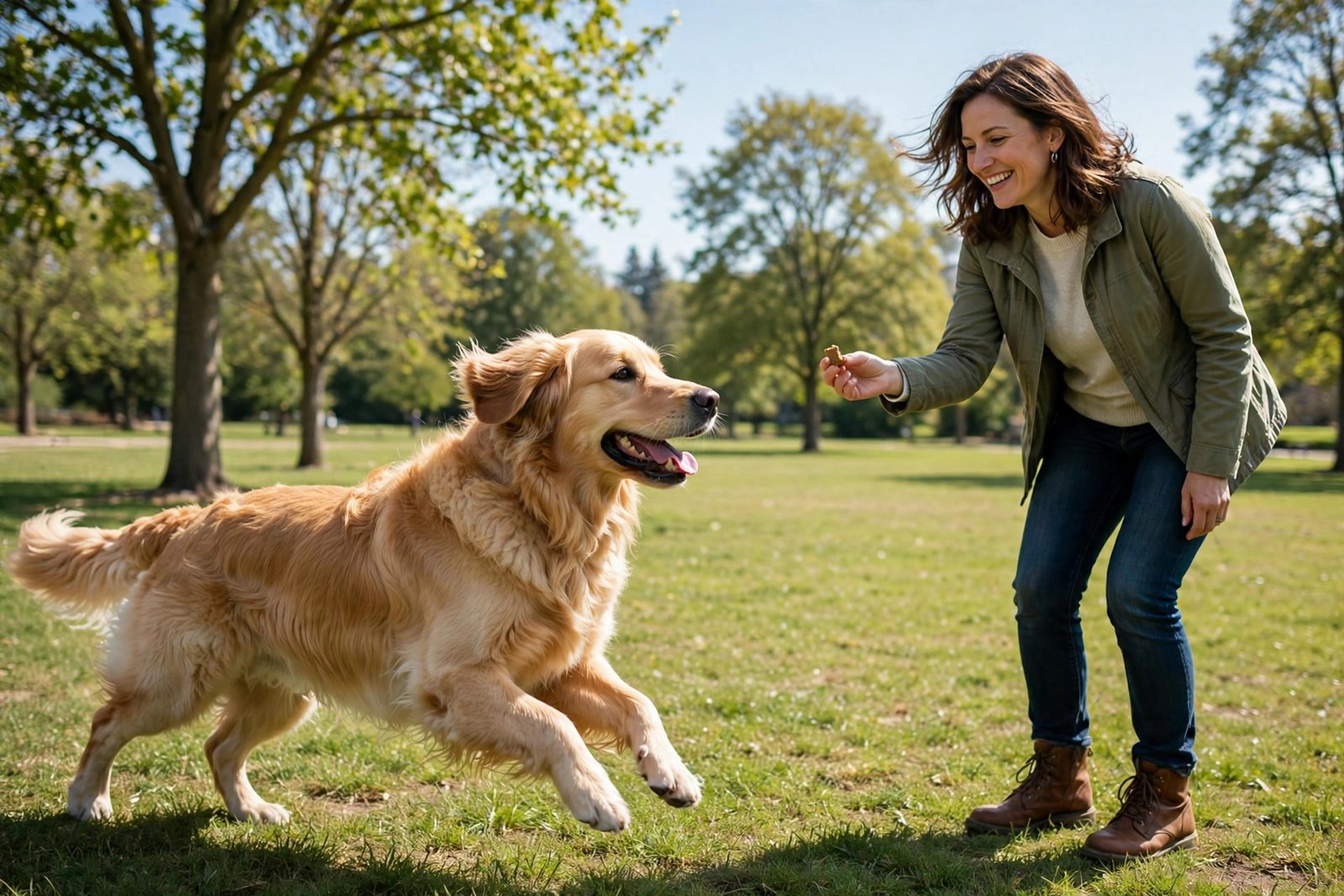
This guide shows you how to teach your dog to come when called, step by step. Of all the things you will ever teach your dog, coming when called is the one that matters most. Sit and stay are useful. A reliable recall can save your dog’s life. A dog that bolts out the front door, slips a leash, or chases a squirrel toward a road has seconds, not minutes, before a bad situation turns into a tragedy. The difference between a dog that turns on a dime and races back to you and a dog that keeps running is training, and it is training any owner can do at home with a pocket full of good treats and a little patience.
Here is the honest truth most recall guides skip: dogs do not come when called because they are obedient. They come because coming to you has always been the best deal on offer. Your job is to make yourself more rewarding than the squirrel, the other dog, the interesting smell, and the mud puddle. Do that consistently for a few weeks and you will have a dog that treats your recall cue like a dinner bell. In this guide, you will learn how to choose a recall word, what rewards actually work, the exact step-by-step progression from your living room to the dog park, the mistakes that quietly destroy recall, and what to do on the day your dog ignores you anyway. No gimmicks, no shock collars, no shouting. Just a method that works.
Why Recall Matters More Than Any Other Cue
Recall is the only cue that is directly tied to your dog’s safety. A dog that will not sit on command is an inconvenience. A dog that will not come when called is a dog you cannot let off leash, cannot trust near an open gate, and cannot call back from a dangerous situation. The American Kennel Club calls recall a potentially lifesaving skill, and they are right: in an emergency, you need to know your dog will come to you no matter what is competing for their attention. The AKC’s own guide to reliable recall training makes the same point, that a dog that comes enthusiastically almost every time is a dog you can keep safe in the real world.
Think about the moments when recall actually gets used. Your dog slips out the front door as a delivery driver arrives. A leash clip fails on a walk. Another dog runs up off leash and yours decides to say hello in the middle of the street. Your dog finds a gap in the fence at the dog park. In every one of these scenarios, you have one tool: your voice. If your dog has a strong recall, you say the word and the problem ends in five seconds. If they do not, you are chasing a dog through traffic, and chasing a dog that is already running away from you is a losing game, as we will cover below.
Recall also buys your dog freedom. Owners with reliable recall dogs can hike off leash where it is legal, play fetch in open fields, and let their dogs swim and explore. Owners without it keep their dogs on a six-foot leash forever. That is not a punishment, and some dogs should stay leashed for life, but the freedom a good recall unlocks is one of the best gifts you can give your dog. The training itself also strengthens your bond. A dog that has learned that coming to you means great things will check in with you voluntarily, look to you for direction, and trust you more in unfamiliar situations.
Choose Your Recall Word Before You Start
Before you train anything, pick one word and commit to it. “Come” is the classic choice and it works fine, provided you have not already worn it out. “Here” is a good alternative, and some trainers prefer it because it is a less common everyday word. Whistle recalls are popular with hunting and sporting dog owners, and they carry beautifully across a field. What matters is not which word you choose but that everyone in the household uses the same one, the same way, every time.
If you have already been saying “come, come, COME!” at a dog who ignores you, your word may be poisoned. A poisoned cue is a word your dog has learned to tune out, or worse, has learned means something unpleasant is about to happen, like the end of playtime or a bath. If that sounds familiar, do yourself a favor and pick a brand-new word. “Here,” “close,” or even a fun word like “pronto” will do. Starting fresh with a new cue is faster than trying to repair a word your dog has already learned to ignore, and it is one of the most underused fixes in dog training.
Your dog’s name is not a recall cue. Their name means “pay attention to me,” and it should be followed by an instruction. If you want, you can pair the two, “Bella, come,” which gives your dog a heads-up that the next word is for them. That pairing is especially useful in a multi-dog household or at the dog park, where a bare “come” might confuse three different dogs at once. Teach the name first if your dog does not already turn and look at you when they hear it. Say their name once in a happy voice, and the moment they look at you, mark it with a “yes” and hand over a treat. Repeat that a dozen times over a few days and their name will reliably mean “look at me.”
One more rule before you start: say the cue once. Just once. Every time you repeat “come” while your dog ignores you, you are teaching them that the first two or three “comes” do not count. Dogs are excellent at learning patterns, and the pattern you want is one word, one response. If you are not confident your dog will respond, do not say the word yet. Go get them, reset the situation, and make it easier next time. Protecting the cue matters more than getting a result on any single repetition.
High-Value Rewards: Pay Like You Mean It
Recall is the hardest thing you will ever ask your dog to do. You are asking them to stop doing something they love and run to you instead. Regular kibble will not cut it. For recall training, you need to pay with the good stuff: small pieces of cooked chicken, cheese, hot dog, freeze-dried beef liver, or whatever your individual dog goes crazy for. The reward has to be better than the distraction, so think of it as a bidding war. A squirrel is a high-value distraction. A piece of dry biscuit is a low-value bid. You will lose that auction every time.
Every dog has their own currency, and part of your job is figuring out what yours values most. Some dogs will do anything for food. Others will choose a tennis ball or a game of tug over any treat on earth. The best recall trainers use a reward hierarchy: ordinary treats for easy indoor reps, and the absolute jackpot, a handful of chicken plus a game of tug, for the hard ones outside. Keep a rotating menu so the reward stays exciting. If your dog starts to look bored, you are not paying enough or you have used the same treat too many times in a row. For ideas on what works best, see our guide to the best treats for training dogs, which breaks down high-value options by dog size and dietary needs.
Delivery matters as much as the treat itself. When your dog arrives, reward them at your side, not by reaching out and grabbing their collar. Many dogs learn that coming to their owner ends with being grabbed, leashed, and taken home, which is exactly why they stop coming. Instead, feed several small treats one after another while praising them, so arriving next to you feels like a jackpot, not a trap. Practice gently taking their collar during training, too, and always follow the collar touch with a treat. That way, when you genuinely need to grab their collar in an emergency, they will not flinch away from your hand.
Jackpot the breakthroughs. The first time your dog leaves a really interesting smell to come to you, or comes running from across the yard, make it a party: five treats in a row, excited praise, a quick game. These are the moments that build a dog’s belief that coming to you is the best decision they can make. Randomly jackpotting a great recall now and then, even months into training, keeps the behavior strong long after the formal training sessions end.
Step-by-Step: How to Teach Your Dog to Come When Called Indoors
Start inside, where there is nothing competing for your dog’s attention. A quiet living room or hallway is perfect. You will need a pocket full of high-value treats, a cheerful attitude, and five minutes. Short sessions are the secret to fast progress. Three five-minute sessions a day will get you further than one miserable thirty-minute session, and your dog will stay enthusiastic instead of checking out halfway through.
Stand just a few feet from your dog and wait until they look at you or start moving toward you. Say their name, then your recall cue, in a bright, happy voice. The moment they move toward you, praise them. When they arrive, feed them several treats at your side. That is one repetition. Repeat it six to eight times, then stop while your dog is still excited. Ending on a high note is how you get a dog that cannot wait for the next session.
Once your dog is turning and coming every time from a few feet away, add the rest of the behavior. When they arrive, ask for a sit before you pay them. You want a dog that comes to you and stops, not one that zooms past you or bounces off your legs and runs away again. A sit on arrival also gives you a calm, controlled dog you can leash, greet, or move safely. If your dog will not sit on arrival yet, do not worry about it. Reward the arrival first and add the sit once the recall itself is solid.
Now add small amounts of movement. Take a step backward as you call, or turn and run a few steps away from your dog while you say the cue. Dogs love to chase a moving target, and running away from your dog is far more effective than standing still and begging. Keep your body language inviting: crouch down, pat your legs, clap your hands, use a silly voice. Whatever gets your dog moving toward you is fair game. If your dog is the nervous type, keep your body low and your movements slow, and let them approach at their own pace. A fearful dog that is rushed will learn that the recall cue means pressure, which is the opposite of what you want.
Build in the collar grab early. Every few repetitions, as your dog arrives and eats their treats, gently touch their collar, say “gotcha” or “thank you,” and hand over another treat. This turns a collar grab into a predictor of good things. It is a small detail that pays off enormously the day you need to take hold of your dog quickly.
Add Distance, Then Distractions
Distance and distraction are the two variables that make recall hard, and the golden rule is to increase only one at a time. Never make a recall both farther and harder in the same session. If you increase distance, keep the environment easy. If you increase distractions, keep the distance short. Dogs that fail repeatedly stop trying, so your job is to set up a long chain of small wins.
Start adding distance inside the house. Call your dog from the other side of the room, then from the hallway, then from another room entirely. Move to different rooms in your home and call them to you from the kitchen while they are in the living room. If they hesitate, go back to an easier distance for a few reps and try again. The goal is a dog that will happily come from anywhere in the house, and that takes a week or two of short daily sessions, not a single afternoon.
Once indoor distance is solid, start adding mild distractions. Train while someone else is in the room. Train while the television is on. Scatter a few boring toys on the floor and call your dog past them. Then try calling them away from a mildly interesting activity, like sniffing a corner of the room. Each new distraction should be easy enough that your dog can succeed. If they fail twice in a row, the distraction is too hard. Move farther away from it, use a better treat, or go back to a shorter distance.
This is also the time to practice the “hidden owner” game. Step around a corner or behind a door and call your dog. Most dogs find this irresistible, and it teaches them to come even when they cannot see you, which is exactly what you need on a trail or in a big yard. Keep it fun and keep the rewards generous. You are building a habit, and habits are built on repetition and reward, not on pressure.
Take It Outside: The Long Line
The backyard is where most recall training falls apart, because owners jump straight from the living room to an off-leash yard. Do not do that. Outside, everything is more interesting: smells, sounds, birds, neighbors, and the sheer joy of open space. The bridge between indoors and off-leash freedom is the long line, a lightweight leash of 20 to 30 feet that lets your dog roam while you stay in control.
Attach the long line to a well-fitted harness, not a collar, so a sudden lunge at the end of the line does not jerk your dog’s neck. Let the line drag on the ground or hold the end loosely, and let your dog wander off and sniff. When they are a few feet away, call them once in your happiest voice. If they turn and come, pay them like they just won the lottery. If they do not, do not repeat the cue and do not reel them in like a fish. Instead, walk toward them calmly, gather up the line as you go, and gently guide them back to you, then reward the arrival. Then reset to an easier distance and try again.
The long line is a safety net, not a fishing rod. Its job is to prevent your dog from practicing the behavior of running away from you, which is what happens every time an off-leash dog ignores a recall and gets away with it. Every successful escape teaches your dog that ignoring you works. The long line removes that option while your dog is still learning. A 20- to 30-foot line is the standard choice for most yards and parks, and you can read our guide to dog leash training for help getting your dog comfortable with leash pressure and loose-leash manners before you start long-line work.
Practice in the yard first, then graduate to quieter outdoor locations: an empty field, a quiet park at off-peak hours, a friend’s fenced yard. Each new location is a step up in distraction, so drop your expectations back down. A dog that recalls perfectly in your backyard may completely ignore you at a new park, and that is normal. New smells and new territory reset the difficulty. Shorten the distance, raise the value of the reward, and rebuild from there.
Keep long-line sessions short and successful. Five minutes of great recalls beats twenty minutes of struggle. End every session with an easy recall your dog can nail, followed by a jackpot. And never use the long line to punish your dog. If you yank them back or drag them toward you, the line becomes something they fear, and they will start avoiding you instead of coming to you.
Common Mistakes That Ruin Recall
Most recall problems are not dog problems. They are owner problems, and they are all fixable once you know what to look for. Here are the five mistakes that do the most damage.
1. Chasing your dog
Chasing a dog that will not come is the single most common recall mistake, and it teaches your dog that running away from you starts a fun game. Dogs love to be chased. If you chase, you are rewarding the exact behavior you are trying to stop. Instead, turn and run away from your dog while calling them in a playful voice. Most dogs cannot resist chasing you. If that does not work, stop, crouch down, and act interested in something on the ground. Curiosity will often bring a dog back faster than any command.
2. Calling your dog, then punishing them
This is the fastest way to destroy a recall. If your dog finally comes to you after ignoring you for ten minutes and you scold them, they learn that coming to you leads to punishment. The lesson they take away is not “I should have come sooner.” It is “coming to my owner is dangerous.” Even if you are furious, even if your dog just rolled in something disgusting, praise and reward the arrival. Deal with the mud later. The arrival is always a good thing, no exceptions.
3. Repeating the cue over and over
“Come, come, come, come, COME!” teaches your dog that the first four “comes” are background noise. Say it once. If your dog does not respond, you asked for too much. Go get them calmly, make the next repetition easier, and try again. A cue said once and followed through is worth ten cues shouted at a dog that has already tuned you out.
4. Only calling your dog to end the fun
If “come” only ever means the walk is over, the leash goes on, and the park fun stops, your dog will start treating it as bad news. Call your dog during fun activities, reward them, and then let them go back to playing. Call them at the dog park, give them a treat, and release them with an “okay, go play.” When the recall cue sometimes means a treat and freedom, your dog will come happily. When it always means the fun ends, they will start weighing their options, and the park will usually win.
5. Practicing only when you need it
A recall that is only tested in emergencies is a recall that fails in emergencies. Practice every day, in low-stakes moments, when you do not actually need your dog to come. The more successful repetitions your dog banks, the more automatic the behavior becomes. Aim for dozens of easy wins every week. The emergency recall is built from a hundred boring ones.
Proofing Recall: Making It Hold Up in the Real World
Proofing means testing a behavior against real-world distractions until it holds up reliably. A recall that works in your living room is not a recall yet. It is a living room trick. To proof it, you need a deliberate plan that adds one challenge at a time: distance, distraction, duration, and new locations.
Work through a distraction ladder. Start with the easiest distractions, like a quiet room with a toy on the floor, and move up gradually: another person in the room, food on the ground, another dog at a distance, a squirrel at the end of the yard. For each new level, shorten the distance and raise the reward value. If your dog succeeds three times in a row, you can make it a little harder. If they fail twice, you went too far too fast. Step back down the ladder.
Vary your position, too. Call your dog while you are sitting, standing, facing away, or partially hidden. Call them while you are holding something, while another family member is talking, or while the doorbell rings. Real life does not happen in a tidy training setup, and your dog needs to learn that the cue means the same thing in all of these situations.
Proofing is never truly finished. Even a dog with a great recall benefits from maintenance: a few recall reps on every walk, a jackpot reward on a random Tuesday, a game of recall in a new place. Think of it like exercise. You do not get fit once and stop. A recall that is practiced stays strong, and one that is neglected fades, usually at the worst possible moment.
Recall Games That Build Speed and Enthusiasm
Games are the fastest way to make recall fun, and a dog that thinks recall is a game will run to you at full speed. Here are four that work for almost every dog.
Ping-pong recall. Two people stand ten to twenty feet apart, each with treats. One person calls the dog, rewards them, and then the other person calls. The dog runs back and forth between you, getting paid at each end. Kids love this game, and dogs love it even more. It builds speed and teaches your dog that coming to different people is rewarding.
Hide and seek. Have someone hold your dog while you hide somewhere in the house or yard, then call them. Your dog has to find you using their ears and nose, and the reunion is a big reward. Start with easy hiding spots and get harder as your dog gets the game. This also teaches your dog to come when they cannot see you, which is an important real-world skill.
Chase me. On a walk, get your dog’s attention, then turn and run a few steps in the opposite direction while calling them. When they catch up to you, make it a party. This game uses your dog’s natural desire to chase, and it is one of the best ways to build a fast, enthusiastic recall. It also works beautifully on a long line in a field.
The treat scatter jackpot. When your dog arrives on a recall, toss a handful of small treats on the ground around your feet instead of handing them one treat. The scramble to find all the treats keeps your dog near you and makes the arrival itself exciting. It is a simple trick, but it turns a basic recall into a mini celebration.
Play these games in short bursts, two or three times a week, and rotate them so they stay fresh. The goal is a dog that hears the recall cue and thinks, “This is going to be great,” not, “I guess I have to go back now.”
What to Do When Your Dog Ignores You
It will happen. Even well-trained dogs have bad days, and a squirrel at ten feet can beat a month of training. What you do in that moment matters more than the failure itself. Stay calm. Do not shout, do not repeat the cue, and do not chase. If your dog is on a long line, calmly walk toward them, gather the line, and guide them back. If they are off leash in a safe enclosed area, turn your back, crouch down, and wait. Many dogs will circle back out of curiosity once the pressure is off.
When your dog finally returns, reward them anyway. This feels wrong to a lot of owners, but it is correct. The dog that comes back late is still a dog that came back, and punishing a late return teaches them not to return at all. Save the frustration for later and make a note of what went wrong. Was the distance too far? Was the distraction too exciting? Was the reward too boring? Every failure is information about what to practice next.
After a failed recall, reset the training. Go back to a shorter distance, an easier location, or a higher-value reward, and get a few easy wins before you try the hard situation again. Dogs learn from success, not from failure. A session that ends with three successful recalls is productive. A session that ends with your dog ignoring you five times in a row teaches them that ignoring you is an option.
If your dog ignores you regularly in a specific situation, stop putting them in that situation until the training catches up. A dog that cannot recall past other dogs should not be off leash around other dogs. A dog that cannot recall from a squirrel should not be off leash where squirrels live. This is not giving up. It is management, and management is what keeps your dog safe while training does its slow work.
Long Leash vs. Off-Leash: When to Make the Jump
The decision to go off leash is the biggest judgment call in recall training, and the honest answer is that many dogs should never be fully off leash in unfenced areas, no matter how good their recall is. Prey drive, fear, and excitement can override even excellent training in a single moment. A dog that chases deer, a dog that panics at loud noises, and a dog that rushes other dogs all carry risks that no amount of training can completely erase. There is no shame in a lifetime long line. A 30-foot line in a field gives your dog freedom to run and sniff while you keep the safety net.
That said, if you do want to work toward off-leash time, use a clear test. Your dog should recall reliably, nine times out of ten or better, on a long line in that exact location, with real distractions present, before you drop the line. Test it first in a fenced area, then in a large open space where you can see for a long way and there are no roads nearby. Keep the first off-leash sessions short, five minutes or less, and end with a successful recall and a jackpot. Gradually extend the time as your dog proves themselves.
Before your first real off-leash outing, make sure the rest of your dog’s leash skills are solid. A dog that pulls, lunges, or panics on leash will not magically behave off leash. If you have not already, read our guide to teaching a dog to walk off leash for the full progression from leash to freedom. And check your local leash laws before you unclip anywhere. Many US cities, counties, and state parks require dogs to be leashed at all times, and some off-leash areas require a permit or a voice-control test. A ticket is the least of your problems if your dog runs into traffic, but it is still a problem you can avoid by knowing the rules.
Always carry high-value treats on off-leash outings, even when your dog’s recall seems perfect. The day you stop carrying treats is the day your dog decides the squirrel is a better deal. A treat pouch on every walk is cheap insurance, and rewarding a recall in the real world keeps it strong for years.
A Realistic Recall Timeline by Age and Breed
How long does recall training take? The honest answer is that it depends on your dog’s age, breed, and history, and anyone who promises a reliable recall in a weekend is selling you something. Here is what to realistically expect.
Puppies, 8 to 16 weeks. Puppies are the easiest to teach because they naturally want to stay close to you. Most puppies will learn to come from across a room within a week or two of short daily sessions. But puppy recall is not reliable recall. It is a baby following its parent. As puppies hit adolescence, around six to eighteen months depending on the breed, their confidence grows, the world gets more interesting, and the recall you thought was solid can fall apart. Plan on retraining through adolescence and do not be surprised when it happens. It is normal, not a failure.
Adolescent dogs, 6 to 18 months. This is the hardest age for recall. Hormones, independence, and a newfound love of other dogs and smells all compete with you. Expect setbacks, keep sessions short and fun, and use the highest-value rewards you have. Many owners feel like their dog has forgotten everything at this age. They have not. They are testing boundaries, and consistent, patient training will get you through it. This is the age where a long line earns its keep.
Adult dogs, 1 to 7 years. A healthy adult dog with no bad recall habits can usually build a solid recall in four to eight weeks of daily practice, moving from indoors to the yard to the long line. An adult dog with a history of ignoring recall, or one that has been allowed to run off leash without training, will take longer, often two to three months, because you are undoing an old habit as well as building a new one. Consistency matters more than intensity. Ten minutes a day beats a weekend boot camp.
Senior dogs, 7 years and up. Older dogs often have the best recall of all, because they are calmer, less distractible, and deeply bonded to their owners. The main challenges are hearing loss and joint pain, so use a louder, clearer cue or add a visual signal like a raised hand, and do not ask an arthritic dog to sprint to you. A slow, happy walk to your side is a perfectly good recall.
Breed differences matter. Retrievers, spaniels, and herding breeds like border collies and Australian shepherds tend to learn recall quickly because they were bred to work closely with people. Independent breeds like huskies, beagles, terriers, and livestock guardian dogs were bred to work at a distance from humans, and their recall takes longer and may never be completely reliable off leash. Scent hounds that catch a trail can go deaf to everything else, which is not stubbornness. It is genetics. Know your breed, set realistic expectations, and never blame your dog for being the dog they were bred to be.
Wherever your dog falls on this timeline, the pattern is the same: train in small steps, reward generously, and do not rush the jump to off leash. A recall that takes three months to build and lasts a lifetime is a better investment than a rushed recall that fails at the dog park.
Frequently Asked Questions
How long does it take to teach a dog to come when called?
Most adult dogs can learn a basic indoor recall in one to two weeks of short daily sessions, but a recall that holds up outdoors with real distractions usually takes four to eight weeks, and adolescent dogs or independent breeds can take two to three months. True reliability is built over months of practice in different locations, not in a single weekend. Keep training in short sessions and do not rush the jump to off-leash freedom.
What is the best recall word to use for my dog?
“Come” works well for most dogs, and “here” is a good alternative. The specific word matters less than consistency, so pick one word and make sure everyone in the household uses it the same way. If you have already repeated “come” at a dog that ignores you, the word may be poisoned, and switching to a fresh word like “here” or “close” will get you faster results than trying to repair the old one.
Why does my dog come inside but ignore me outside?
Outside is a completely different training environment, with smells, sounds, other animals, and open space competing for your dog’s attention. Your dog has not forgotten the cue. They have not learned it in that context yet. Go back to short distances on a long line, use higher-value rewards like chicken or cheese, and rebuild the behavior outdoors step by step instead of expecting your indoor recall to transfer on its own.
Should I punish my dog when they finally come after ignoring me?
No, never. Punishing a dog for coming back, even a late return, teaches them that coming to you leads to bad things, and they will be slower to return next time. Always praise and reward the arrival, no matter how long it took. If your dog ignored you, the training setup was too hard, so make the next repetition easier with a shorter distance or a better reward.
Is it safe to let my dog off leash once their recall is good?
It depends on your dog, the location, and local leash laws. Many dogs with excellent recall are still safer on a long line in unfenced areas, especially high prey-drive breeds and dogs that chase wildlife or panic at loud noises. Test recall on a long line in the exact location first, start with short off-leash sessions in safe, fenced areas, and always carry high-value treats. If you are not confident, there is no rule that says your dog must ever be off leash.