
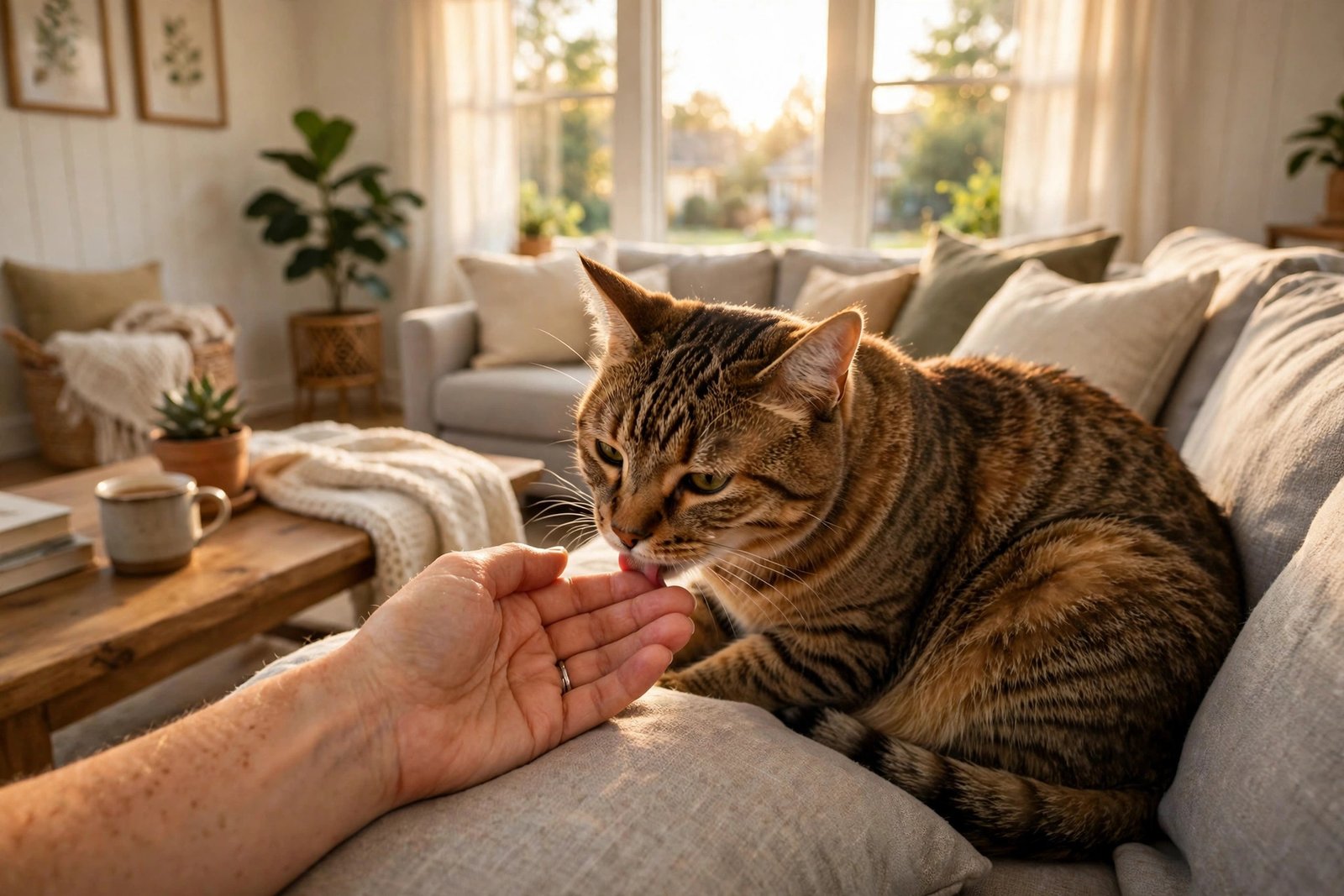
If your cat has ever settled on your lap and started licking your hand, your arm, or even your face with its rough little tongue, you have probably wondered what it means. Why does my cat lick me is one of the most common questions cat owners ask, because licking can feel sweet one minute and strangely persistent the next. Is your cat showing love? Is it grooming you like a kitten? Is it tasting the salt on your skin? Or is something wrong? The truth is that cats lick people for several different reasons, and the meaning depends on the context, the body language, and how often it happens. Most of the time it is a compliment. Sometimes it is a habit. And occasionally it is a signal worth paying attention to.
A cat’s tongue is a remarkable tool. It is covered in tiny, backward-facing spines called papillae, which is why it feels like sandpaper. Those spines help a cat groom its fur, strip meat from bones, and lap up water. When your cat turns that tongue on you, it is using its most personal grooming tool on a member of its social group. In cat society, grooming is a big deal. Cats that like each other groom each other. Mothers groom kittens. Bonded pairs of adult cats spend long minutes licking each other’s heads and necks, in a behavior called allogrooming. When your cat licks you, it is very often treating you the way it would treat a cat it trusts and loves. That is a high honor in the feline world, even if it leaves your arm a little damp.
But affection is not the only reason. Cats also lick because they like the taste of your skin, because they are anxious, because they want something, or because they have learned that licking gets your attention. Some cats lick obsessively when they are stressed or in pain, and that version of licking looks and feels very different from a relaxed, affectionate lick. Learning to tell the difference is the key to understanding your cat, and to knowing when to enjoy it and when to gently redirect it.
Why Does My Cat Lick Me? The 7 Main Reasons
Here are the most common reasons, starting with the ones you will see most often in a happy, healthy cat.
1. Affection and social bonding
This is the number one reason, and the one most owners hope for. Cats groom the individuals they feel bonded to. When your cat licks your hand while purring, with relaxed ears and slow blinks, it is saying, in the clearest language it has, that you belong to its group. Mother cats lick their kittens from birth to clean them, stimulate them, and bond with them. Adult cats that live together continue that behavior with each other. Your cat has simply extended that circle to include you.
Affectionate licking often comes with other signs of contentment. Your cat may knead your lap at the same time, a leftover behavior from kittenhood that signals comfort and happiness. You can read more about that in our article on why cats knead blankets. The cat may also headbutt you, rub its cheek against you, or settle down next to you afterward. If the licking is slow, rhythmic, and paired with purring, it is almost certainly affection. Enjoy it. Your cat is telling you it loves you in the most cat-like way possible.
2. You taste interesting
Let us be honest: humans taste salty, and cats notice. Your skin carries sweat, skin oils, lotions, and the faint residue of whatever you last ate or touched. After a workout, your skin is saltier than usual, and many cats find that irresistible. The same goes for hands that smell like chicken, tuna, or the treat bag. Some cats are drawn to specific lotions, soaps, or sunscreens, and will lick your arms for minutes after you apply them.
This is usually harmless, but it is worth checking the ingredients of anything you put on your skin. Some lotions, essential oils, and medications that are safe for people can be toxic to cats if licked repeatedly. Products containing permethrin, tea tree oil, or certain pain-relief creams are particular concerns. If your cat is obsessed with licking a spot where you applied a cream or ointment, cover it or keep your cat away until it absorbs, and ask your veterinarian if you are unsure whether a product is safe. The ASPCA Animal Poison Control Center maintains guidance on common household products that are dangerous to pets, and it is a good resource to bookmark.
3. Grooming you as part of the family
Closely related to affection, but slightly different, is the idea that your cat sees you as a fellow cat that needs grooming. Cats groom each other in hard-to-reach places, especially the head, ears, and neck. That is why many cats focus their licking on your hair, your ears, your face, or your hands. From your cat’s point of view, you are a large, mostly hairless cat that is terrible at grooming itself, and it is doing you a favor.
This is especially common in cats that were raised with other cats and learned allogrooming early. It is also common in cats that are very bonded to one person in the household. If your cat only licks you and ignores everyone else, take it as a compliment. You are its chosen grooming partner.
4. Seeking attention or food
Cats are fast learners. If licking your hand in the morning has ever resulted in you getting up and filling the food bowl, your cat has learned a powerful lesson: licking works. Many cats develop a morning routine of licking their owner’s face or hands as a polite but persistent alarm clock. It is more effective than meowing, because it is hard to ignore a sandpaper tongue on your cheek at 5 a.m.
Attention-seeking licking tends to be short, insistent, and paired with eye contact or meowing. Your cat licks, looks at you, and waits to see what you do. If you respond by petting, talking, or feeding, you have reinforced the behavior. That is not necessarily a problem. If you enjoy the interaction, there is nothing wrong with it. But if the licking is waking you up too early or becoming demanding, the fix is to respond less. Do not push your cat away angrily, which can create stress. Instead, calmly redirect to a toy, or get up and start your day without making a fuss over the lick itself.
5. Stress, anxiety, or boredom
Not all licking is happy licking. Cats that are anxious, bored, or stressed sometimes lick excessively, either themselves or their owners. This is a self-soothing behavior, a bit like a person biting their nails or tapping their foot. The licking releases endorphins and helps the cat calm down, but if it becomes constant, it can be a sign that something in the cat’s environment needs to change.
Stress licking looks different from affectionate licking. It tends to be faster, more intense, and harder to interrupt. Your cat may lick your hand repeatedly without purring, with tense body language, flattened ears, or a twitching tail. It may also over-groom its own belly or legs, sometimes to the point of hair loss or skin sores. Common stress triggers include a new pet or baby in the home, a move, loud construction, a change in routine, or a lack of play and enrichment. If your cat’s licking has suddenly increased and you cannot find an obvious cause, think about what has changed in your household in the past few weeks.
The fix for stress licking is to address the stress, not just the licking. Add play sessions, create safe hiding spots, keep feeding and litter box routines consistent, and use a Feliway diffuser, which costs around $25 to $40 for a starter kit, if your veterinarian recommends it. If the over-grooming continues or your cat is losing fur, see your vet. A routine exam in the United States typically costs $50 to $80, and it is worth it to rule out medical causes before assuming the problem is behavioral.
6. A learned habit from kittenhood
Some cats lick people simply because they always have. Kittens that were weaned too early, or orphaned and bottle-fed, sometimes develop oral habits that last into adulthood, including licking, suckling on blankets, and kneading. These behaviors are comforting to the cat, a link back to the safety of nursing. A cat that licks your hand and then falls asleep is often a cat that finds the rhythm soothing.
This kind of licking is harmless as long as it does not become obsessive. It is part of who your cat is. Trying to eliminate it completely can cause more stress than it solves. Gentle redirection is a better approach if it bothers you.
7. A medical issue
Occasionally, excessive licking is a medical symptom rather than a behavioral one. Cats with nausea, gastrointestinal problems, or mouth pain may lick their lips, the air, or nearby surfaces repeatedly. Cats with skin allergies may lick themselves and anything nearby. Cats with hyperthyroidism, a common condition in older cats, can become restless and over-groom. And cats with a condition called pica may lick and chew non-food items like plastic, fabric, or cords, which can be dangerous.
The warning signs that licking has crossed from normal to medical include licking that is constant and cannot be interrupted, licking of floors, walls, or air rather than people, drooling, vomiting, diarrhea, weight loss, hair loss, or skin sores. If you see any of those, do not wait. Book a vet visit and mention the licking specifically. Bring a video if you can. Blood work to check thyroid levels, kidney function, and other common issues typically costs $100 to $200 in the United States, and it can catch problems early when they are easiest to treat. For a full breakdown of what to expect at the vet, see our guide to how much a vet visit costs.
Is It Safe to Let Your Cat Lick You?
For most healthy adults, a cat licking your hand or arm is perfectly safe. Cat saliva does contain bacteria, including a germ called Pasteurella, which can cause infection if it gets into an open wound. That is why you should not let a cat lick an open cut, a surgical incision, or broken skin, and why you should wash your hands after a long licking session. People with weakened immune systems, including those undergoing chemotherapy or living with certain chronic conditions, should be a bit more careful and talk to their doctor about pet contact.
You should also never let a cat lick your face if you have just applied medication, sunscreen, or insect repellent, and you should keep cats away from any area where you have applied topical medicine until it has fully dried. If your cat licks a spot where you used a medicated cream and then starts drooling, vomiting, or acting lethargic, call your veterinarian or the ASPCA Poison Control hotline right away. The hotline charges a consultation fee, usually around $95, but it is staffed by veterinary toxicologists around the clock and can be lifesaving in a poisoning emergency.
One more safety note: a cat’s mouth is not clean in the way people sometimes claim. Cat bites and deep scratches can become infected quickly, and any bite that breaks the skin should be washed thoroughly and monitored. Licking is much lower risk than biting, but the same basic hygiene applies. Wash up, keep wounds covered, and enjoy the affection without worry.
How to Tell Affectionate Licking From Problem Licking
The simplest test is context. Ask yourself three questions. First, when does it happen? Affectionate licking usually happens during relaxed moments: on the couch, in bed, or while you are petting your cat. Problem licking happens at odd times, lasts a long time, and is hard to interrupt. Second, what does your cat’s body look like? A relaxed cat has soft ears, slow blinks, and a loose body. A stressed or painful cat has tense muscles, dilated pupils, flattened ears, or a flicking tail. Third, is your cat licking anything else? A cat that licks you, its own belly, the floor, and the couch is showing a pattern, not a preference, and that pattern deserves a vet check.
If you are ever unsure, take a video and show it to your veterinarian. Vets would much rather see a video of normal behavior and reassure you than miss an early sign of a medical problem. You know your cat better than anyone, and if the licking feels different from how it used to be, trust that instinct.
What to Do If Your Cat Licks You Too Much
Even when licking is affectionate, it can become too much. Some cats lick for ten or fifteen minutes straight, or wake their owners up every night. Here is how to set gentle limits without damaging your bond.
Redirect, do not punish
Never yell at, spray, or push your cat away roughly for licking. Punishment does not teach a cat what to do instead, and it can damage trust. Instead, when the licking goes on too long, calmly move your hand away and offer a toy, a treat puzzle, or a petting session on your cat’s terms. Many cats will happily switch from licking to playing if you offer a wand toy at the right moment.
Give your cat something else to lick
Lick mats are a brilliant solution for cats that love to lick. You spread a thin layer of wet food, plain pumpkin puree, or a lickable cat treat on a silicone mat, and your cat spends ten happy minutes licking the mat instead of your arm. A lick mat costs $8 to $15, and it is one of the cheapest enrichment tools you can buy. It also slows down fast eaters and provides mental stimulation. Just be sure to use cat-safe foods and to wash the mat after each use.
Keep your cat busy
A bored cat is a cat that finds its own entertainment, and sometimes that entertainment is your arm. Two play sessions a day, puzzle feeders, a window perch with a view of birds, and rotating toys all help. A cat that has hunted, played, and explored is a cat that is much more likely to settle down for a nap instead of a marathon licking session. If your cat is especially active at night, a good play session in the evening can help it sleep better, which benefits both of you.
Check the routine
If the licking is mainly a morning wake-up call, try an automatic feeder. A basic timed feeder costs $30 to $60 and can deliver a small meal at 5 a.m. without you having to get up. Many cats stop waking their owners once food arrives on a reliable schedule. Similarly, if the licking happens every time you sit down to work, your cat may simply want attention. A scheduled play break before you start work can fill that need in advance.
The Difference Between Licking, Biting, and Love Bites
Some cats lick and then suddenly bite, which can be confusing and a little painful. This is often called a love bite, and it is usually not aggression. Cats groom each other with a mix of licking and gentle nibbling, and your cat may be treating your hand the same way it would treat another cat’s fur. The nibble is part of the grooming sequence. That said, a bite that breaks skin is never okay, and you should not let your cat practice biting on your hands, even gently, because it teaches the cat that hands are toys.
If your cat licks and then bites, the best response is to go still, say a calm “ow,” and slowly withdraw your hand. Do not yank your hand away quickly, which can trigger a chase reflex. Then redirect to a toy. Over time, your cat will learn that licking gets petting and attention, while biting ends the interaction. For more on why cats bite during affection, read our article on why cats bite their owners.
It is also worth noting that some cats lick as a warning before they bite. If you are petting your cat and it starts licking your hand rapidly while its tail begins to flick, that can be a sign of overstimulation. Your cat is telling you it has had enough petting for now. Stop petting, let your cat walk away, and it will come back when it is ready. Learning to read these signals is one of the most useful skills a cat owner can develop.
Why Does My Cat Lick My Hair, Face, or Feet?
Different body parts attract cats for different reasons. Hair is a common target because it smells like you, holds shampoo scent, and resembles fur. Many cats love to lick and even chew their owner’s hair, especially long hair, while kneading. It is a grooming behavior, and it is usually harmless, though it can be annoying if your cat wakes you up by licking your hair at 3 a.m.
Faces are targeted because they are warm, salty, and expressive. A cat that licks your nose or chin is usually showing deep affection, though it can also be investigating the smell of your toothpaste or moisturizer. Feet attract cats because they are sweaty and salty, especially after a day in shoes. Some cats are obsessed with feet and will wait by the shower or the bed for a chance to lick toes. It is weird, it is gross, and it is completely normal cat behavior.
If your cat licks a specific spot obsessively, like the same patch of your arm every day, it is worth checking whether something about that spot is attracting it, such as a new lotion, a healing cut, or a change in your skin. Cats have a sense of smell far better than ours, and they can detect changes we cannot. That is not a reason to panic, but it is a reason to pay attention.
The Bottom Line
So, why does my cat lick me? Most often, because it loves you and considers you part of its family. Licking is grooming, and grooming is how cats say “you belong with me.” It can also mean you taste salty, your cat wants breakfast, or it learned long ago that licking gets your attention. Those are all normal, healthy reasons. The version to watch for is licking that is constant, frantic, hard to interrupt, or paired with other symptoms like hair loss, vomiting, or drooling. That kind of licking deserves a vet visit, because it can point to stress, pain, or a medical problem. For the everyday licks, though, the answer is simple: your cat likes you, it trusts you, and it is treating you the way it treats the cats it loves most. Wash your hands, enjoy the compliment, and keep a lick mat handy for the days when your arm needs a break.
Frequently Asked Questions
Why does my cat lick me all the time?
Most cats lick their owners as a sign of affection and social bonding, similar to how cats groom each other. It can also mean your cat likes the salty taste of your skin, wants attention or food, or finds licking soothing. Constant, frantic licking that is hard to interrupt may signal stress or a medical issue and should be checked by a vet.
Is it okay to let my cat lick my face?
Occasional licking of intact skin is generally safe for healthy adults, but you should avoid letting your cat lick open cuts, wounds, or skin where you have applied medication, sunscreen, or lotion. Wash your hands and face afterward, and be extra cautious if you have a weakened immune system.
Why does my cat lick me and then bite me?
This is often part of normal grooming behavior, where cats mix licking with gentle nibbling, just as they do with other cats. It can also be a sign of overstimulation during petting. Go still, calmly withdraw your hand, and redirect your cat to a toy rather than letting it practice biting on hands.
Why does my cat lick my hair?
Cats lick hair because it smells like you, holds shampoo scent, and feels similar to fur. It is a grooming behavior that shows affection and bonding. It is usually harmless, though you may want to redirect your cat with a toy if it wakes you up at night.
When should I worry about my cat licking too much?
See a vet if the licking is constant and cannot be interrupted, if your cat licks floors, walls, or the air, or if it comes with drooling, vomiting, diarrhea, weight loss, hair loss, or skin sores. These signs can point to stress, allergies, nausea, dental pain, or thyroid problems.