
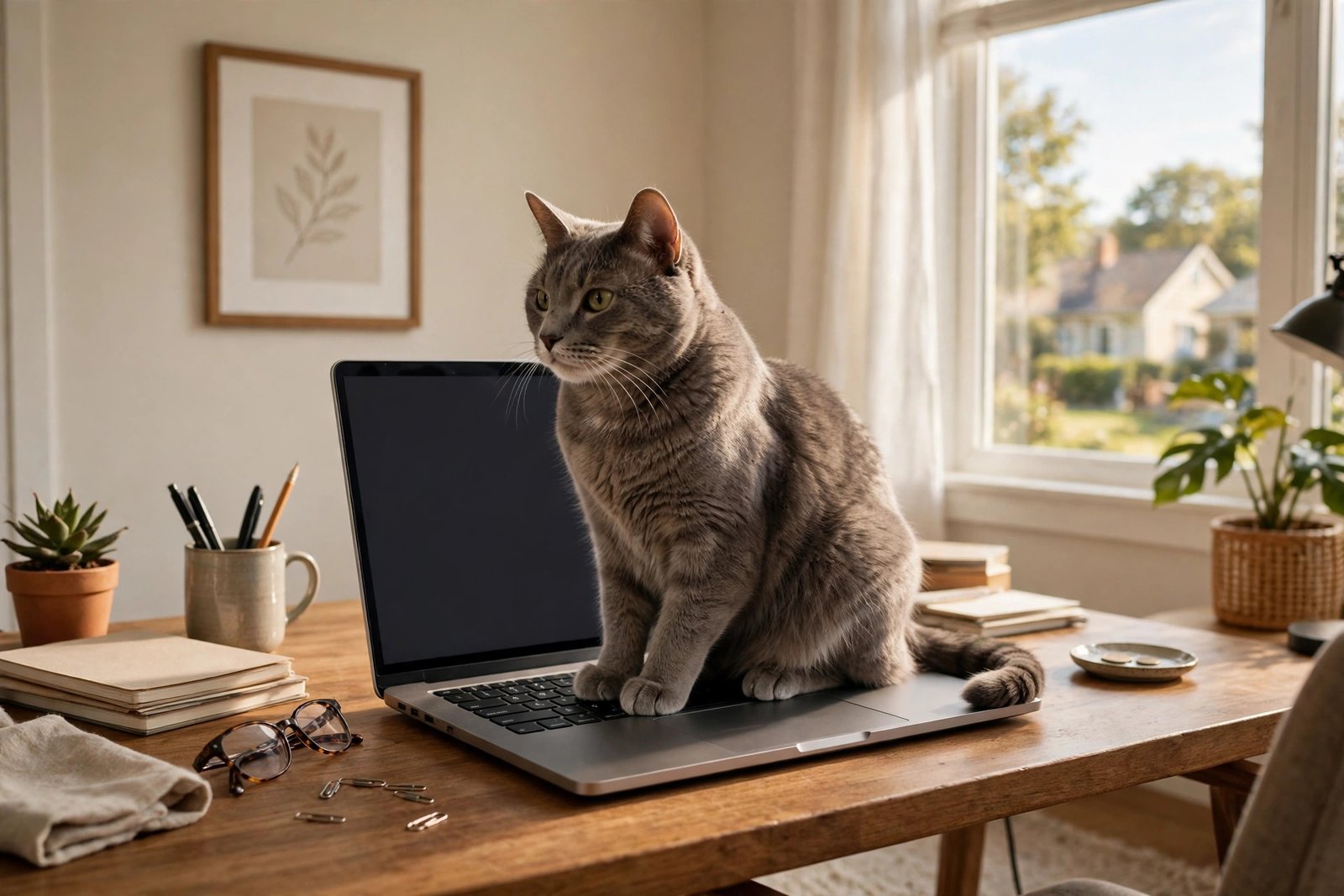
You open your laptop to answer one quick email, and within thirty seconds your cat is sitting directly on the keyboard, tail draped across the screen, staring at you with complete satisfaction. Why does my cat sit on my laptop is a question that every cat owner who works from home has asked, usually while trying to type around a furry body. It is funny, it is frustrating, and it is one of the most predictable behaviors in the feline world. Your cat is not trying to ruin your work. It is not confused about what a laptop is. It is doing something that makes perfect sense from a cat’s point of view, and once you understand the reasons, you can work with the behavior instead of fighting it every day.
The simplest explanation is warmth. Cats love warm places, and a laptop is a small, reliable heater that sits at exactly the right height. A cat’s normal body temperature is around 101 to 102.5 degrees Fahrenheit, higher than a human’s, which is why cats are always seeking out sunny windowsills, heating vents, and warm laundry. A laptop that has been running for a while puts out a steady, gentle heat that is almost irresistible to a cat. Add in the fact that the keyboard is flat, slightly textured, and just about cat-sized, and you have the perfect napping spot, at least from your cat’s perspective.
But warmth is only part of the story. Your cat is also sitting on your laptop because it is yours, because it smells like you, and because sitting on it gets your attention every single time. Cats are territorial animals, and they mark the things that matter to them by sitting on them, rubbing against them, and leaving their scent behind. Your laptop is one of the most important objects in your life. You touch it for hours every day. Of course your cat wants to claim it. And when your cat sits on it, you look at your cat, you talk to your cat, and you give it exactly what it wanted: your full attention.
Why Does My Cat Sit on My Laptop? The 6 Main Reasons
1. It is warm
This is the reason most veterinarians mention first, and it is hard to argue with. Cats seek out temperatures between 86 and 97 degrees Fahrenheit for resting, which is warmer than most American homes are kept. A laptop, especially one running video calls or a demanding program, can easily reach 100 degrees or more on its surface. To a cat, that is a heated bed that turns itself on every morning.
The warmth is even more appealing in winter, when your home is cooler and your cat is looking for any heat source it can find. If your cat only sits on your laptop during the colder months, warmth is almost certainly the main driver. The fix is to offer something warmer nearby. A heated cat bed costs $30 to $60, and a simple self-warming mat, which reflects your cat’s own body heat, costs $15 to $25. Place it right next to your desk, and many cats will happily choose the bed over the keyboard, at least some of the time.
2. It smells like you
Cats live in a world of scent in a way humans can barely imagine. Your laptop smells like you. Your hands rest on it for hours, your face is close to it during video calls, and it carries the scent of your home, your coffee, and your daily routine. To your cat, that scent is comfort. Sitting on your laptop is a way of surrounding itself with your smell, which is deeply reassuring, especially when you are busy and not paying attention to it.
This is the same reason cats sit on your clothes, your pillow, and the exact spot on the couch where you just sat. They are not being difficult. They are seeking out the places that smell most like the person they are bonded to. A cat that sits on your laptop is a cat that likes being close to you, even if it expresses that closeness by blocking your screen. If your cat also follows you from room to room and sleeps on your side of the bed, it is showing the same attachment in different ways. You can learn more about that closeness in our article on why cats sleep on their owners.
3. It gets your attention, every time
Let us be honest about the cause and effect here. The first time your cat sat on your laptop, what did you do? You probably laughed, took a photo, talked to your cat, and maybe gave it a pet. Your cat learned instantly that the laptop is a magic attention button. Sit on it, and the human stops what they are doing and looks at you. From a cat’s point of view, that is a perfect system.
This is why the behavior gets stronger over time, not weaker. Every time you react, even if you gently lift your cat off and set it aside, you have still given it attention. Cats do not distinguish between positive attention and annoyed attention the way people do. Attention is attention. If you want to reduce laptop sitting, you need to make the alternative more rewarding than the laptop itself, which means giving your cat attention and play before you sit down to work, and having an appealing spot right next to you that is not the keyboard.
4. Territory and claiming
Cats mark their territory by rubbing their cheeks, paws, and bodies against objects, leaving behind scent from glands in those areas. Sitting on something is a strong form of claiming. Your laptop is a high-value object in your cat’s territory because you spend so much time with it. By sitting on it, your cat is saying, “This is mine, and so are you.”
This is the same instinct that makes cats sit on books, newspapers, and paperwork. It is not a coincidence that cats always choose the one piece of paper you are reading, or the one box you just opened. They are drawn to the objects you focus on, because those objects are important in their territory. Your laptop is simply the most important object of all in a modern home office.
5. The keyboard is the perfect size and shape
A laptop is, by accident, almost perfectly cat-sized. It is flat, rectangular, slightly raised, and just big enough for a cat to curl up on. Many cats prefer to sit on objects that fit their body, because it gives them a sense of security and containment. It is the same reason cats love boxes, laundry baskets, and sinks. A laptop offers that same snug fit, with the bonus of warmth and your scent.
The keyboard also gives a cat something to do. Those little keys are fun to step on, and the screen changes when they do. Some cats seem genuinely fascinated by the moving cursor or the changing images on the screen. They are not trying to send an email, though cat owners have plenty of stories about cats that did exactly that. They are just playing with an interesting, responsive surface that happens to be your work tool.
6. Your cat wants to be near you
At the end of the day, the simplest reason may be the most important one. Your cat likes being near you. When you sit down at your laptop, you settle in one place for a long time, and your cat settles with you. The laptop just happens to be between you and your cat. If your cat could sit on your lap while you worked, it probably would, and many cats do exactly that when given the chance. The laptop is the next best thing, because it is warm, it smells like you, and it puts your cat right in the center of your attention.
Cats are often described as aloof, but that reputation is unfair. Most house cats are deeply social with their chosen people. They follow their owners around the house, greet them at the door, and choose to sleep nearby. Sitting on your laptop is one more way of staying close. If your cat also headbutts you or rubs against you when you come home, it is showing the same social bonding in a different form. Read our article on why cats headbutt their owners to learn more about that behavior.
Is It Bad for Your Cat to Sit on a Laptop?
In most cases, no. Sitting on a laptop is harmless for a healthy cat, as long as a few basic precautions are in place. The main risk is overheating, both for the cat and for the laptop. A cat sitting on a laptop blocks the ventilation, which can cause the laptop to overheat and shut down. It can also make the surface uncomfortably hot for the cat, though most cats will move if they get too warm. If your laptop feels very hot to the touch, or if the fan is running loudly all the time, do not let your cat sit on it for long stretches.
There is also a small risk to the laptop itself. Cat hair can get into the keyboard and the vents, and a cat’s claws can scratch the screen if it steps on it. Spilled water from a nearby glass, knocked over by a tail, is a bigger risk than the cat itself. None of this is a reason to panic, but it is a reason to save your work often, keep drinks away from the desk, and consider a keyboard cover if your cat is a dedicated laptop sitter. A silicone keyboard cover costs $10 to $20 and can save you from a costly repair.
One thing to watch for is whether your cat is chewing on the power cord. Some cats are drawn to cords, and a laptop charger is a tempting target. Chewing on a plugged-in cord is dangerous and can cause burns or electric shock. If your cat shows interest in cords, use cord covers, which cost $10 to $15 for a pack, and keep the charger out of reach when you are not using it. The ASPCA offers practical guidance on making a home office safe for cats, including cord management and toxic plants to avoid.
How to Keep Your Cat Off Your Laptop Without a Fight
You do not need to ban your cat from your desk. You just need to give it a better option. Cats respond far better to redirection than to punishment, and a cat that has a warm, comfortable spot next to you will usually choose it over the keyboard, at least most of the time.
Set up a desk-side perch
Place a cat bed, a folded blanket, or a small cat perch on your desk or on a chair right beside you. The key is location. The spot needs to be close enough that your cat still feels near you, and warm enough to compete with the laptop. A heated bed or a self-warming mat works best. Put a treat or a bit of catnip on the new spot the first few times, and praise your cat calmly when it uses it. Most cats figure out the new system within a few days.
Play before you work
A ten-minute play session with a wand toy before you sit down to work can make a huge difference. A cat that has just hunted, caught its toy, and eaten a small treat is much more likely to settle down for a nap than to demand your attention. This is especially useful if you work from home and your cat’s peak activity time lines up with your work hours. Morning and evening are the natural hunting times for cats, so a play session at the start of your workday is ideal.
Use a decoy keyboard
This is a classic cat-owner trick, and it works surprisingly well. Place an old keyboard, a spare laptop that no longer works, or even a small box next to your real laptop. Many cats will happily sit on the decoy, because from their point of view it is just as good: warm-looking, flat, and yours. You can find a used keyboard for $5 to $10 at a thrift store, and it is a small price to pay for a clear screen.
Close the laptop when you step away
If you leave your desk for a few minutes, close the laptop or put it in sleep mode. An open, warm laptop is an invitation. A closed laptop is just a flat surface, and it is much less interesting. This also protects your work from accidental key presses and unsent emails, which are a real risk with a curious cat.
Stay calm and consistent
When your cat does sit on your laptop, calmly pick it up and place it on its bed or perch. Do not yell, spray water, or push it off the desk. That kind of reaction creates stress and can damage your cat’s trust in you, and it rarely stops the behavior in the long run. Consistency matters more than intensity. If you move your cat to its spot every single time, calmly and without drama, most cats learn the routine within a week or two. And yes, your cat will still test you occasionally. That is part of living with a cat.
What If Your Cat Only Sits on Your Laptop When You Are Busy?
Many owners notice that their cat ignores the laptop all day, but the moment an important video call starts, the cat appears and sits directly on the keyboard. This is not a coincidence. Cats are very good at reading human attention. They notice when your focus shifts, when your voice changes, and when you are looking at the screen instead of at them. A video call is a perfect trigger, because you are talking, gesturing, and completely focused on something that is not your cat.
The solution is the same as above: play before the call, set up a perch nearby, and keep a few treats handy. Some owners also keep a favorite toy on their desk to offer during calls. If your cat does make a cameo on a call, most colleagues find it charming, and it is rarely a problem unless you are in a formal meeting. A quick, calm removal and a treat on the cat bed usually solves it without drama.
It is also worth considering whether your cat is bored. A cat that sits on your laptop every time you work may simply need more enrichment during the day. Puzzle feeders, window perches with a view of birds, and rotating toys can keep a cat occupied while you work. A cat that is mentally stimulated is a cat that is less likely to demand your attention by sitting on your keyboard. For ideas on keeping an indoor cat happy, our article on why cats get the zoomies explains how pent-up energy shows up in cats and how to burn it off with play.
When Laptop Sitting Might Signal Something Else
Most laptop sitting is normal, but a sudden change in the behavior is worth noting. If your cat has never cared about your laptop and suddenly starts sitting on it constantly, ask yourself what else has changed. Is your cat seeking warmth because it is cold, or because it is not feeling well? Cats that are sick sometimes seek out warm places more than usual. Is your cat suddenly clingy in other ways too, following you everywhere and meowing more? That can be a sign of anxiety, pain, or a medical issue, especially in senior cats.
The same applies if your cat is sitting on the laptop and also showing other changes, like eating less, hiding more, vomiting, or losing weight. Those symptoms, combined with a change in behavior, deserve a vet visit. A routine exam in the United States typically costs $50 to $80, and it is a small price for peace of mind. Mention the behavior change to your vet, along with any other symptoms you have noticed. Vets are used to hearing about odd behavior changes, and they know which ones matter.
For most cats, though, laptop sitting is just laptop sitting. It is a warm, familiar, attention-grabbing spot that belongs to the most important person in the house. Your cat is not trying to sabotage your career. It is just being a cat.
The Bottom Line
So, why does my cat sit on my laptop? Because it is warm, it smells like you, it is the perfect size, and it guarantees your attention every single time. Your cat is claiming a high-value object in its territory, staying close to the person it loves, and enjoying a heated bed that turns on every morning. It is normal, it is common, and it is actually a compliment, even if it does make work harder. The best fix is not to fight your cat, but to offer a better alternative: a warm bed right beside you, a play session before work, and a decoy keyboard for the days when nothing else will do. Save your work often, keep a keyboard cover handy, and enjoy the fact that your cat would rather sit on your laptop than anywhere else in the house. That is love, with a little bit of mischief mixed in.
Frequently Asked Questions
Why does my cat sit on my laptop every time I use it?
Because the laptop is warm, smells like you, and sitting on it always gets your attention. Cats learn quickly that the laptop is a reliable way to be near you and to interrupt your focus, so the behavior gets stronger each time you react.
Is it bad for my cat to sit on my laptop?
Usually not, as long as the laptop is not overheating. A cat can block ventilation and cause the laptop to run hot, and cat hair can get into the keyboard. Keep the laptop cool, save your work often, and use a keyboard cover if your cat is a regular laptop sitter.
How can I keep my cat off my laptop while I work?
Offer a warm bed or perch right next to your desk, play with your cat for ten minutes before you start work, and try a decoy keyboard beside your real one. Calmly move your cat to its spot each time, and reward it for using the alternative.
Why does my cat sit on my laptop during video calls?
Cats notice when your attention shifts to the screen and your voice changes. A video call signals that you are focused on something else, which makes it the perfect moment for your cat to claim your attention by sitting on the keyboard.
Does my cat sit on my laptop because it loves me?
Yes, in its own way. Sitting on your laptop is a sign your cat wants to be close to you, enjoys your scent, and considers your belongings part of its territory. It is a form of bonding, even if it is inconvenient for your work.