
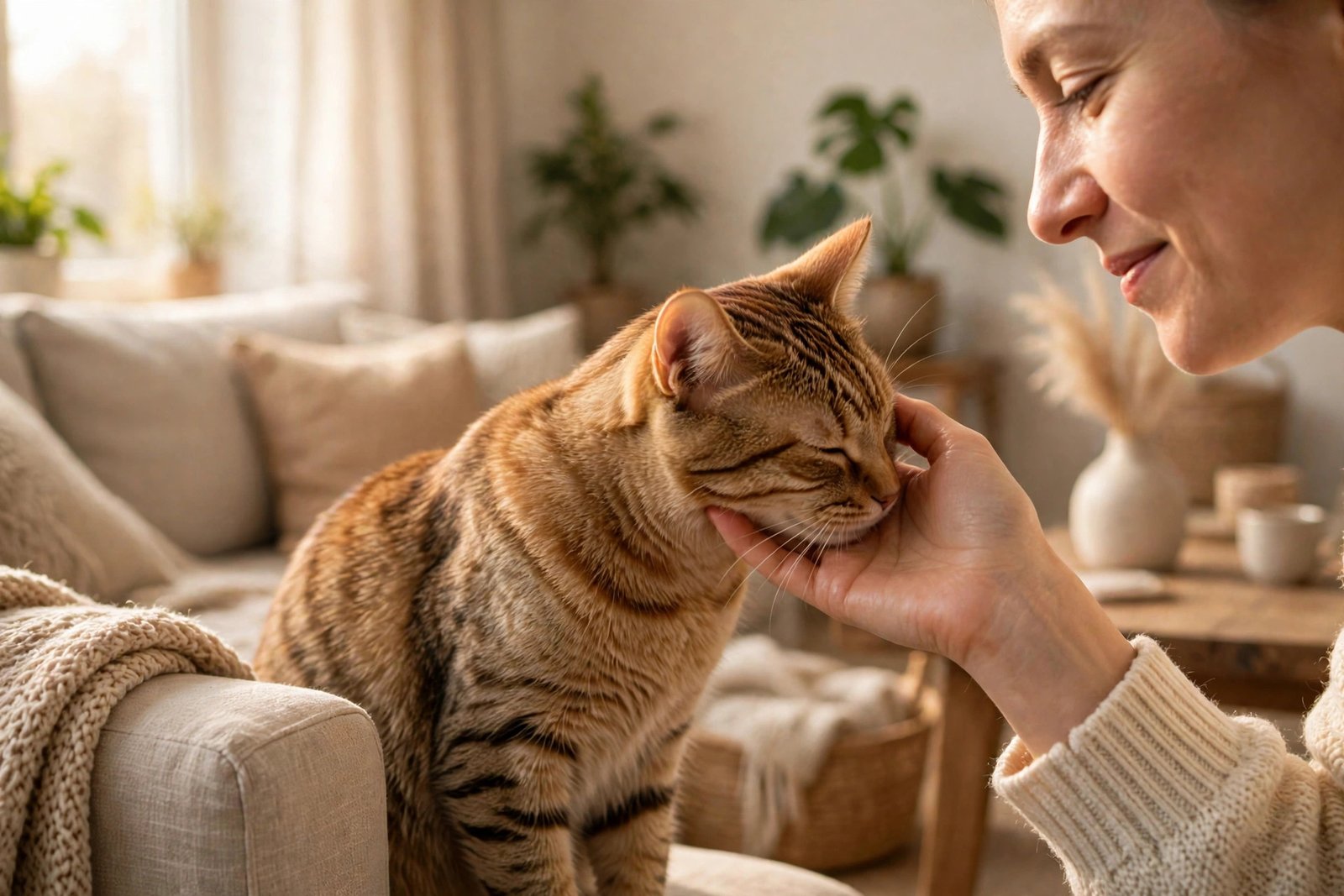
There are few things more endearing than a cat walking up to you, pressing its forehead firmly against your face, your hand, or your leg, and giving you a slow, deliberate headbutt. If you have ever experienced it, you have probably wondered: why does my cat headbutt me? Is it an accident? Is your cat trying to get your attention? Is it a sign of affection, or is something wrong? The answer is reassuring: headbutting is one of the most affectionate things a cat can do, and it is a behavior with deep roots in how cats communicate, bond, and mark their world.
Cat behaviorists call this behavior bunting, and it is one of the clearest signs that your cat considers you part of its family. Unlike a playful swat or an accidental bump, a headbutt is deliberate. Your cat walks up to you on purpose, aims for you, and presses its head against you — sometimes gently, sometimes with surprising force. It may follow the headbutt by rubbing its cheek along your hand or your leg, or by weaving between your ankles. Each of those movements has a purpose, and understanding them will help you appreciate just how much your cat is saying with a single bump of its head.
Why Does My Cat Headbutt Me? The Meaning of Bunting
Bunting is a behavior kittens learn almost as soon as they are born. Newborn kittens bunt against their mother to stimulate milk flow and to find a nipple, and the behavior stays with them for life as a social signal. Adult cats bunt each other, they bunt objects, and — most importantly for us — they bunt their favorite humans. When your cat headbutts you, it is treating you the way it would treat another cat it loves and trusts. Here is what is really going on.
1. Your Cat Is Marking You as Its Own
The most important reason cats headbutt is scent-marking. Cats have scent glands on their forehead, cheeks, chin, and around their ears, and these glands produce pheromones — chemical signals that are unique to each cat. When your cat presses its head against you and rubs, it is depositing those pheromones on you. In cat language, that means: this person belongs to me, and this person is safe.
This is the same reason your cat rubs against furniture, door frames, and the corners of walls. It is building a map of safe, familiar things by marking them with its scent. When it marks you, it is including you in that map. It is also mixing its scent with yours, creating a shared group scent that says you belong together. That is why cats often headbutt you more after you come home from work, after a shower, or after you have been around other animals — your familiar scent has changed, and your cat is refreshing the mark. The behavior is so fundamental that behaviorists consider it one of the strongest signs of feline affection there is.
2. Your Cat Is Showing Affection and Trust
A headbutt is a vulnerable gesture. To bunt you, your cat has to close its eyes, lower its head, and press one of the most sensitive parts of its body against you. A cat would never do that to a creature it feared or distrusted. When your cat headbutts you, it is saying that it feels completely safe with you — safe enough to close its eyes and let its guard down.
Watch what happens right after the headbutt. Many cats follow it with a slow blink, a soft purr, or a relaxed flop onto their side. Those are all signs of a content, trusting cat. Some cats headbutt and then immediately present their head for a scratch, which is an invitation to return the affection. If you respond with a gentle scratch behind the ears or under the chin, you are speaking your cat’s language, and you will probably get another headbutt in return. It is a conversation, and it is one of the sweetest conversations you can have with a pet. For more on how cats show love, read our guide to why cats purr — headbutting and purring often happen together.
3. Your Cat Wants Your Attention
Sometimes a headbutt is a request. Your cat has learned that bunting gets a response — a scratch, a kind word, a treat, or a lap to sit on — and it uses the behavior to ask for what it wants. This is especially common in the morning, when your cat wants breakfast, or in the evening, when you sit down on the couch and your cat wants to claim the prime spot on your lap.
Attention-seeking headbutts are usually paired with other signals: a tail held high, ears forward, and a purposeful walk straight toward you. Your cat may bunt your hand repeatedly until you start petting it, or bunt your leg and then look up at you expectantly. This is not demanding behavior in a bad sense — it is your cat communicating clearly and politely. Responding with a few minutes of attention is a good idea, because a cat whose social needs are met is a happier, calmer cat. Just be careful not to reward headbutting with food every time, or your cat may start headbutting you awake at 4 a.m. in search of breakfast.
4. Your Cat Is Greeting You
Cats that are bonded to each other greet one another with headbutts. It is the feline equivalent of a hug or a handshake, and your cat is offering you the same greeting it would offer a beloved feline friend. Many owners notice that their cat headbutts them most enthusiastically when they come home after being away — after work, after a trip to the store, or after a vacation. The headbutt is part of the homecoming ritual, along with the chirp, the upright tail, and the figure-eight weave between your legs.
This greeting behavior is a good sign. It means your cat missed you, or at least noticed your absence, and is happy you are back. Cats that greet their owners with headbutts tend to be confident, social cats with strong attachment bonds. If your cat greets you this way, take a moment to return the greeting — crouch down, offer your hand or your forehead, and let your cat bunt you. It costs you nothing, and it reinforces the bond between you.
5. Your Cat Is Asking for Food or a Door to Be Opened
Not every headbutt is purely emotional. Cats are practical creatures, and they quickly learn that a headbutt is an effective way to get a human to do something. A cat that headbutts you while standing next to its food bowl is not making a philosophical statement about love — it wants dinner. A cat that headbutts your leg while you are standing near a closed door wants the door opened. A cat that headbutts your hand while you are holding a phone wants you to put the phone down and pay attention to it instead.
Context is everything. Look at where the headbutt happens and what is nearby. If it happens at the same time every day, near the same place, your cat has a routine request. The best response is to meet the reasonable requests — food at mealtimes, a door opened when appropriate — while keeping a consistent schedule so your cat does not need to demand things at odd hours. A predictable routine reduces demanding behavior, because your cat learns that its needs will be met on schedule.
Headbutting vs. Head Pressing: An Important Difference
There is one critical distinction every cat owner needs to know: headbutting is normal and affectionate, but head pressing is a medical emergency. They look similar, and confusing them can be dangerous. Headbutting — bunting — is a quick, deliberate press of the head against you or an object, followed by rubbing and then moving on. Your cat is alert, responsive, and behaving normally otherwise.
Head pressing is different. A cat that is head pressing will press its head against a wall, a floor, or a piece of furniture and hold it there for a long time, without moving or rubbing. The cat may seem disoriented, confused, or unresponsive, and it may pace in circles or stare blankly. Head pressing is a sign of a serious neurological problem — it can indicate a brain tumor, a head injury, a liver problem, or an infection affecting the brain. According to the Cornell Feline Health Center, any cat that is persistently pressing its head against a surface needs emergency veterinary care. If you ever see your cat doing this, do not wait — call your veterinarian or an emergency animal hospital immediately.
The key difference is simple: bunting is social and brief, and your cat is engaged with you. Head pressing is compulsive, prolonged, and your cat seems disconnected from its surroundings. Once you know the difference, you will never confuse them again — but it is worth learning, because it could save your cat’s life.
Do All Cats Headbutt?
Not every cat is a headbutter, and that is perfectly normal. Some cats show affection in other ways: by sleeping on you, by following you from room to room, by slow-blinking, or by bringing you a toy. Cats that were not handled much as kittens, or that had a stressful early life, may be slower to headbutt — or may never do it at all. That does not mean they love you any less. It means their love language is different.
Breed plays a role too. Siamese, Ragdoll, Maine Coon, and Burmese cats are known for being especially affectionate and are often enthusiastic headbutters. More independent breeds, like the Russian Blue or the Norwegian Forest Cat, may be less demonstrative. Age matters as well: kittens and young cats often headbutt more as they are learning social skills, and some cats become more affectionate — and more inclined to bunt — as they get older and more settled.
If your cat does not headbutt, do not try to force it. Hold your hand out at your cat’s head height and let it come to you. If it chooses to bunt your hand, great. If it walks past, that is fine too. Affection cannot be forced, and a cat that feels pressured will only become more wary. Patience and consistency are the best tools for building trust with a shy cat. Our article on how to socialize a puppy covers similar trust-building principles, and many of the same ideas — patience, positive reinforcement, and letting the animal set the pace — apply to shy cats as well.
How to Respond When Your Cat Headbutts You
The best response to a headbutt is a gentle, positive one. You can scratch behind your cat’s ears, rub under its chin, or simply offer your hand or your forehead for another bunt. Many owners find that their cat has a favorite spot for scratches — behind the ears, under the chin, or at the base of the tail — and learning your cat’s preference is part of the fun of living together.
You can also try returning the headbutt very gently. Lean your forehead toward your cat’s forehead and hold still. Many cats will press back, and it is a lovely moment of connection. Do not push hard, and never grab your cat’s head or force it toward you. Let the cat control the interaction. If your cat walks away after one headbutt, it has said what it wanted to say, and that is fine.
If your cat headbutts you constantly and seems anxious — headbutting every surface, pacing, and meowing at the same time — it may be a sign of stress or overstimulation. Give your cat some space, check whether something in the environment has changed, and make sure it has a quiet place to retreat to. Cats that are overstimulated during petting may headbutt as a warning before they bite or scratch, so watch for other signals like a twitching tail, flattened ears, or dilated pupils. If you see those signs, stop petting and give your cat a break. You can learn more about that warning sequence in our article on why cats bite.
When Headbutting Could Mean Something Is Wrong
Headbutting is almost always a happy behavior, but there are a few exceptions worth knowing. If your cat suddenly starts headbutting much more than usual, and the behavior is paired with other changes — loss of appetite, hiding, vomiting, lethargy, or a change in litter box habits — it could be a sign that your cat is seeking comfort because it does not feel well. Cats that are in pain or anxious often become clingier and seek more physical contact with their owners.
Similarly, if your cat is headbutting hard surfaces repeatedly and seems disoriented, as described above, that may be head pressing rather than bunting, and it needs urgent veterinary attention. And if your cat is an older cat that has started headbutting and yowling at night, it could be a sign of cognitive dysfunction or a thyroid problem. A routine vet visit in the United States typically costs $50 to $100, and a blood panel to check thyroid and kidney function usually runs $100 to $250. If the behavior change is sudden or paired with other symptoms, do not wait to find out — call your veterinarian. You can see a full breakdown of what a visit costs in our article on how much a vet visit costs.
The Bottom Line
So, why does my cat headbutt me? Because it loves you, trusts you, and is marking you as part of its family. Bunting is your cat’s way of saying you belong together — it is sharing its scent, offering a greeting, asking for attention, and showing affection all at once. It is one of the most charming behaviors in the feline world, and it is a privilege to be on the receiving end.
Enjoy the headbutts. Respond with a gentle scratch, a slow blink, or a soft forehead press of your own. And remember the one exception: if the headbutt ever turns into long, blank, compulsive pressing against a wall or floor, treat it as an emergency and call your veterinarian right away. Otherwise, relax. Your cat is not trying to tell you something is wrong. It is trying to tell you that you are its favorite person.
Frequently Asked Questions
Why does my cat headbutt me every morning?
Morning headbutts are usually a greeting combined with a request for breakfast. Your cat is happy to see you and is reminding you that it is feeding time. A consistent feeding schedule reduces early-morning demands.
Is it okay to headbutt my cat back?
Yes, gently. Lean your forehead toward your cat and hold still, letting your cat press back. Never push hard or grab your cat’s head. Let your cat control the pressure and the timing.
Why does my cat headbutt me and then bite me?
This is often overstimulation. Your cat was enjoying the attention and then reached its limit. Watch for warning signs like a twitching tail, flattened ears, or skin rippling along the back, and stop petting before your cat gets overwhelmed.
What is the difference between headbutting and head pressing?
Headbutting is brief, social, and deliberate — your cat presses against you, rubs, and moves on. Head pressing is prolonged, compulsive pressing against a wall or floor with a disoriented, unresponsive cat, and it is a medical emergency.
Why does my cat headbutt objects like walls and furniture?
Your cat is scent-marking its territory. Rubbing its head on door frames, furniture, and walls deposits pheromones that mark those objects as safe and familiar, building a scent map of home.
1 thought on “Why Does My Cat Headbutt Me?”