
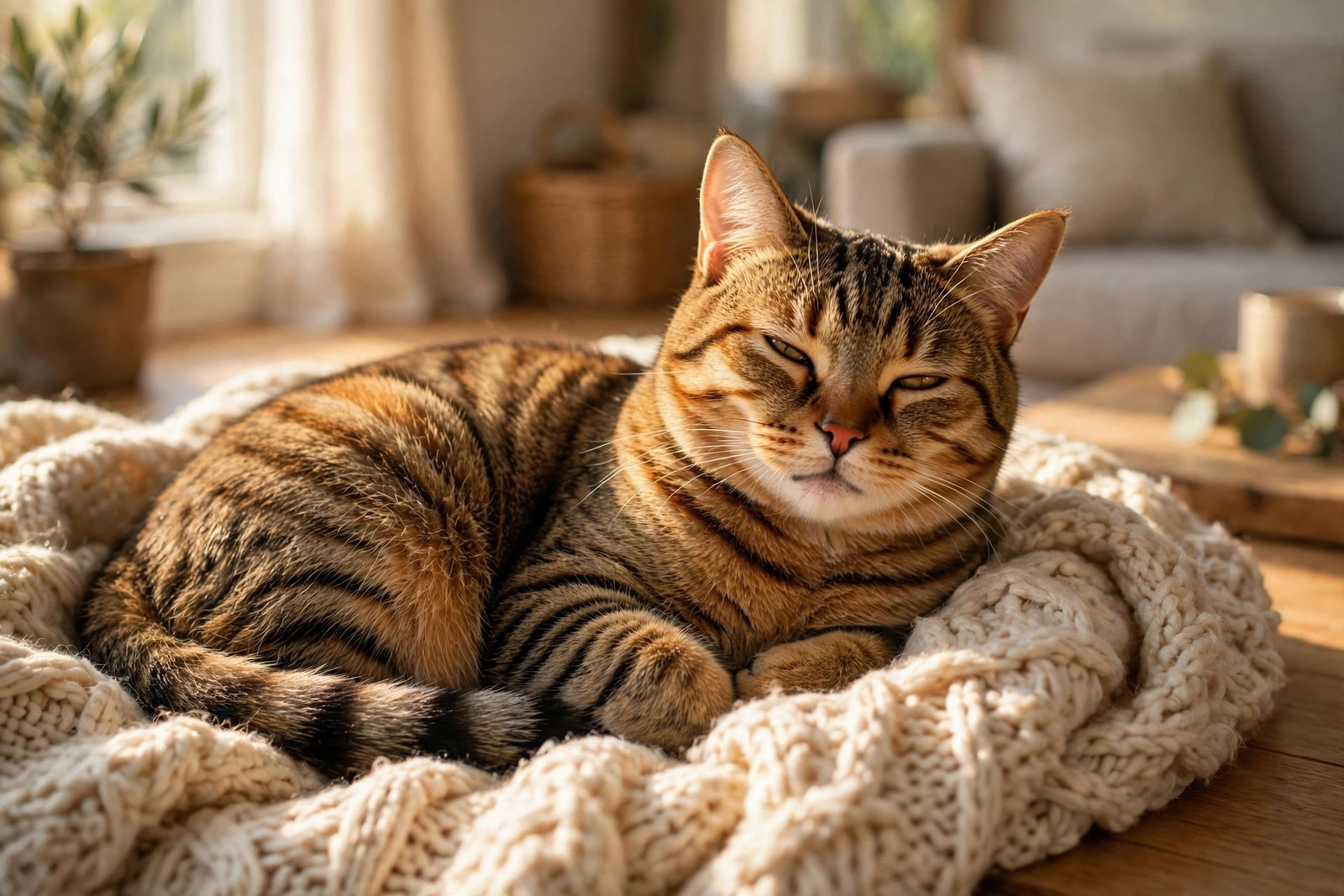
Ever wondered why do cats purr? If you share your home with a cat, you know the sound. That low, steady rumble starts up the moment you sit down, and within seconds your cat is vibrating against your leg like a small motor that someone forgot to switch off. Most of us take it as a simple compliment: my cat is happy. And most of the time, that is exactly right.
But purring is not a one-word language. Cats also purr when they are frightened, in pain, at the vet, giving birth, and sometimes when they are dying. The same sound can mean “I love this” and “please help me,” and the difference is everything around it: the body language, the ears, the tail, the situation, and whether anything else about your cat has changed.
This guide breaks down what purring actually is, how cats make the sound, every reason they do it, what the research really says about purring and healing, and — most importantly — how to tell the difference between a contented purr and a purr that should send you to the veterinarian. No myths, no magic, just what we know and what is still honest guesswork.
What Is Purring, Exactly?
A purr is a low-frequency, rhythmic vibration that a cat produces while breathing in and out. Unlike a meow, which happens on the exhale, a cat can purr continuously through both parts of the breath. That is why a purr can go on for minutes without a pause: the cat never has to stop to take a breath.
The sound usually sits somewhere around 25 to 50 cycles per second for the main rumble, with higher-frequency components layered on top. To your ear it reads as a soft, rolling buzz. To your hand, if the cat is on your lap, it reads as a gentle vibration through the whole body. Some cats purr so quietly you have to put your hand on their throat or chest to feel it. Others purr loudly enough to hear from across the room, and a few sound like a broken lawnmower.
Purring is not limited to domestic cats. Cheetahs, cougars, bobcats, and servals purr too. Lions and tigers, on the other hand, cannot truly purr — their throat anatomy is built for roaring instead. That split is one of the classic dividing lines in the cat family: the cats that roar do not purr, and the cats that purr do not roar.
It is also worth knowing that not every cat purrs the same way, or the same amount. Some cats are enthusiastic purrers from kittenhood. Others purr rarely, and a few almost never do, without anything being wrong with them. A cat that does not purr much is not necessarily unhappy, just as a cat that purrs constantly is not necessarily fine. What matters is what is normal for your cat, and whether that pattern changes.
How Do Cats Produce the Purring Sound?
Here is the honest answer first: scientists still do not fully agree on the exact mechanism. We can put a person on the moon and treat a cat’s cancer with chemotherapy, but the precise physics of the purr remain partly unresolved — a point veterinarians at the Cornell Feline Health Center have made with admirable humility.
The leading explanation goes like this. A signal from the cat’s brain tells the muscles of the larynx — the voice box — to twitch rapidly, about 25 to 50 times per second. Each twitch briefly separates the vocal cords. At the same time, the diaphragm pushes air through the airways and across the vocal cords, and the rapid opening and closing creates the vibration we hear as a purr. Because the cycle repeats on both the inhale and the exhale, the sound never breaks.
A more recent study complicated that tidy picture. In 2023, researchers passed air through the removed larynxes of domestic cats and found that the tissue itself could vibrate at purring frequencies of around 25 to 30 Hz without any active muscle contractions at all. Special connective tissue in the vocal folds, the researchers suggested, may help small cats produce such a low sound passively. That does not disprove the muscle-twitch theory in living cats — the brain signal and the tissue properties may both play a role — but it shows the mechanism is more interesting, and less settled, than the textbooks used to claim.
What is not in doubt is that purring is largely involuntary, like breathing. A cat does not have to think about purring the way it thinks about meowing at you for dinner. That reflex-like quality is part of why purring shows up in so many different situations: it is a built-in response the cat’s nervous system can reach for whether the cat is blissful, nervous, or hurting.
For more on how cats communicate through the sounds they make, the Cornell Feline Health Center explains the mechanics and meanings of purring in detail at https://www.cathealth.com/behavior/how-and-why/1243-cat-purr.
Why Do Cats Purr When They Are Happy and Content
This is the purr everyone knows, and it is the most common reason by far. A relaxed cat on a warm lap, in a sunny window, or curled up next to its favorite person will often purr steadily. In these moments the purr is a genuine expression of pleasure, comfort, and safety. The cat is telling you, in the only way it can, that right now everything is good.
Look at the rest of the body to confirm it. A contented purring cat usually has soft, half-closed eyes — the slow blink that cat behaviorists call a sign of trust. Its ears are in a neutral, forward position. Its body is loose and floppy, not tense. The tail is still or gently curled. The whiskers are relaxed. And crucially, the cat chose to be there. A happy purr is almost always a voluntary purr: the cat walked over, climbed up, and settled in.
Cats also purr during other pleasurable moments that have nothing to do with you. They purr while eating a favorite meal, while grooming themselves in a sunbeam, while kneading a soft blanket, and while settling down for a nap. Kneading and purring often go together because both behaviors trace back to kittenhood, when kneading the mother stimulated milk flow and purring signaled that everything was fine. If your cat kneads and purrs on your lap, you are getting the highest compliment a cat can pay. You can read more about that behavior in our guide to why cats knead blankets.
Some cats also purr as a social greeting. Your cat may start purring the moment you walk through the door, or when a familiar feline housemate comes over for a mutual grooming session. In multi-cat households, purring during grooming or resting together is a sign of a friendly, bonded relationship — the feline equivalent of a relaxed conversation between friends.
Purring When Stressed, Scared, or in Pain
Here is the part that surprises most owners: cats purr when they are frightened, hurt, or sick. Veterinarians see it every day. A cat on the exam table, terrified, with its ears flat and its pupils huge, will often purr loudly through the entire visit. A cat recovering from surgery may purr in its cage. Cats in labor purr. Cats with serious injuries purr. This is not happiness. It is self-soothing.
The best way to think about it is to compare it to a person humming or rocking when they are anxious. The rhythmic vibration appears to be calming — to the cat itself. Purring is associated with the release of endorphins, the body’s natural painkillers, which flow both when we are ecstatic and when we are in distress. That may help explain why the same behavior shows up in the best and worst moments of a cat’s life.
Purring in a stressful situation may also be a social signal. A frightened cat at the vet may be signaling “I am not a threat, please do not hurt me” to the strange humans and animals around it. In the wild, a sick or injured cat that purrs when approached by another cat may be defusing a confrontation it cannot afford. A purr can be a white flag as well as a love letter.
How do you tell the difference? Context and body language, every time. A stressed purr usually comes with tense body language: ears flattened or rotated sideways, pupils dilated into big black circles, whiskers pulled back tight, tail tucked or lashing, body crouched low, fur puffed up. The cat may be hiding, refusing food, or trying to escape. If the purr is happening in a situation your cat clearly hates — the carrier, the vet’s office, a house full of strangers — do not assume it means the cat is fine. It almost certainly means the opposite.
This is also why a sudden change in purring habits deserves attention. If a cat that rarely purrs suddenly starts purring all day, or a cat that used to purr only on your lap starts purring while hiding under the bed, something has changed. The purr itself is not the problem; it is the clue.
Purring at the Vet: What It Really Means
If your cat purrs at the vet, do not be reassured by it — and do not be alarmed by it either. It is simply very common, and it tells the vet almost nothing on its own. Veterinary staff know this well. They read the ears, the breathing rate, the muscle tension, and the willingness to eat, not the purr.
What you can do is help your vet by reporting what is normal at home. “She purrs on my lap every evening but never purrs in the carrier” is useful information. “He has been purring nonstop since yesterday and has not eaten” is even more useful, and it is the kind of detail that can change how quickly your cat is seen.
To make vet visits less stressful, keep the carrier out in the open at home so it is furniture, not a trap. Put a familiar blanket inside. Use a calming pheromone spray on the carrier bedding about 30 minutes before you leave. Cover the carrier with a towel in the car and in the waiting room so your cat is not staring at strange dogs. And do not punish a cat that purrs, hides, or growls at the clinic — it is coping the only way it knows how.
The 25–150 Hz Question: Can Purring Heal?
You have probably seen the claim online: cats purr at frequencies that heal bones, reduce inflammation, and lower blood pressure, so owning a cat is basically medicine. It is an appealing idea, and it contains a grain of truth — but the popular version of it goes far beyond what the evidence actually supports, so let us be careful here.
Here is what is real. Domestic cats purr at frequencies roughly in the range of 25 to 150 Hz. In human medicine, mechanical vibrations in a similar frequency range — around 25 to 50 Hz — have been used in research on bone density and muscle recovery. A widely cited 2001 conference paper recorded the purrs of 44 individual felids and noted that their dominant frequencies fell in a range that overlaps with frequencies associated in other studies with bone healing and pain relief. That overlap is interesting. It is not proof of anything.
Here is what is not established. No controlled study has shown that a cat’s purring heals a broken bone, repairs tissue, or cures any disease — in cats or in people. The 2001 paper was a meeting abstract, not a clinical trial, and it measured frequencies; it did not demonstrate healing. Frequency is only one part of a vibration treatment. Dose, magnitude, duration, and how the vibration actually reaches the tissue all matter, and a cat sitting on your chest is not delivering a calibrated medical device. The endorphin release associated with purring is real, and feeling calmer and less stressed genuinely helps people and animals cope with illness — but coping is not curing.
There is also a sensible biological idea behind the healing hypothesis that is worth mentioning honestly. Cats may purr when injured partly because the vibration helps them in some way — perhaps by stimulating bone and tissue maintenance during long periods of rest, since cats sleep so much. It is a plausible evolutionary story. Plausible is not proven, and responsible sources, including Cornell’s veterinarians, present it as an intriguing possibility rather than a fact.
So what should you take away? Enjoy the idea that your cat’s purr might be good for both of you. There is decent evidence that interacting with a calm, purring cat lowers human stress and blood pressure in the moment — the same way any pleasant, relaxing activity does. Just do not use purring as a substitute for veterinary care. A purring cat with a broken leg still needs an X-ray, a cast, and pain medication. A purring cat that has stopped eating still needs a vet, no matter how soothing the sound is.
Kittens and Mother Cats: Where Purring Begins
Purring starts almost immediately. Kittens are born blind and deaf, and they begin purring when they are only a few days old — long before they can see or hear properly. Their first purrs happen while they are nursing, and they serve a practical purpose: a purr is quiet, it does not carry far, and it lets the mother know where her kittens are and that they are content, without alerting predators.
The mother purrs back. She often purrs while nursing, and the kittens use the vibration like a homing beacon to find her in the dark nest. The sound becomes the family’s first language — a reassurance signal that says “I am here, you are safe, everything is all right.” That early association between purring, warmth, food, and safety is almost certainly why adult cats still purr in moments of comfort, and why kneading, nursing behavior, and purring remain linked for life.
As kittens grow, purring becomes social. They purr with littermates during play and grooming, and they purr with humans who handle them gently. Kittens that are handled often and kindly in their first weeks tend to grow into adults that purr readily with people. Kittens that miss that early socialization window may purr less with humans as adults — not because they are unhappy, but because people were never fully folded into their comfort circle.
If you have a new kitten, the best thing you can do is be calm, predictable, and gentle. Let the kitten come to you. Keep handling sessions short and positive. A kitten that purrs in your hands is learning that humans are safe, and that lesson lasts a lifetime.
The Solicitation Purr: When Purring Means “Feed Me”
Not all purrs are equal, and your cat knows it. In a 2009 study published in Current Biology, researcher Karen McComb and her colleagues found that cats use a special kind of purr when they want something — usually food. The “solicitation purr” embeds a high-frequency cry, similar in pitch to a human baby’s cry, inside the normal low purr. Humans, even people who do not own cats, consistently rated the solicitation purr as more urgent and harder to ignore than a regular purr.
You have probably heard it. It is the purr that starts at 5:30 in the morning, gets louder when you do not move, and escalates until you are standing in the kitchen opening a can. It is not an accident. Cats have learned, over thousands of years of living with humans, which sounds get a response. The regular purr says “I am content.” The solicitation purr says “I am content, and also, I would like breakfast now, please.”
This is not manipulation in any mean sense — it is communication. Your cat has figured out that a certain sound reliably produces food, attention, or a door being opened, so it uses that sound. If the morning purr is driving you crazy, the fix is boring but effective: do not reward the 5 a.m. version. Feed on a consistent schedule, use an automatic feeder with a timer if you need to, and avoid getting up to feed in response to the purr. Cats learn fast when a behavior stops working.
Purring vs. Other Cat Sounds: How to Tell Them Apart
Purring is only one item on a cat’s vocal menu, and confusing it with other sounds can lead you to misread your cat entirely. Here is a quick field guide.
Meowing
Adult cats rarely meow at each other. Meowing is mostly a language cats developed for humans. A short, high-pitched meow is usually a greeting or a request. A long, drawn-out meow is often a demand — food, a door, attention. A low, yowling meow can signal distress, pain, or disorientation, especially in older cats, and deserves a vet check if it is new. Unlike purring, meowing happens only on the exhale.
Chirping and Trilling
A chirp is a short, birdlike sound cats make when they spot prey through a window — or when they are excited and want you to follow them. A trill is a rolling, musical sound, a bit like a purr mixed with a meow, and it is almost always friendly. Mother cats trill to call their kittens, and adult cats trill as a greeting. If your cat trills at you, it is saying hello.
Growling, Hissing, and Spitting
These are the sounds that mean “back off.” A growl is a low warning. A hiss is an explosive “leave me alone.” Spitting is a hiss with extra emphasis. A cat making these sounds is frightened or angry, and its body language will match: ears flat, pupils dilated, body tense. Do not try to pick up or soothe a hissing cat with your hands — give it space. If your cat is hissing or growling during handling, that is also a signal to check whether something hurts, since pain makes even gentle cats defensive. For context on how pain and fear show up in handling, see our guide to why cats bite — biting, like hissing, is often a cat saying “that hurts” or “I have had enough.”
Chattering
Chattering is the rapid teeth-clicking sound cats make while watching birds or squirrels they cannot reach. It is usually accompanied by intense focus, twitching whiskers, and a wiggling rear end. Nobody knows exactly why cats chatter — excitement, frustration, or a kind of practice for the killing bite are all plausible — but it is normal and not a cause for concern.
Yowling
A yowl is a long, loud, mournful cry. Unspayed females yowl when in heat. Older cats with cognitive decline or hearing loss may yowl at night. A cat in pain may yowl too. New, frequent yowling is always worth a vet visit, especially if it comes with restlessness, disorientation, or appetite changes.
The key point is that no single sound tells the whole story. A purr plus relaxed body language is contentment. A purr plus flat ears and a crouched body is fear. A meow plus a tail held high is a happy greeting. Read the whole cat, not just the soundtrack.
When Purring Signals a Problem: Warning Signs to Watch For
Most purring is perfectly normal. But purring combined with any of the following signs should prompt a call to your veterinarian — promptly, and the same day if several of them appear together.
- Purring plus not eating or drinking. A cat that purrs while refusing food for more than 24 hours needs to be seen. Cats that stop eating can develop fatty liver disease quickly, sometimes within two to three days, and that condition is serious.
- Purring plus hiding. A cat that hides and purrs at the same time is not relaxing. It is coping. If your normally social cat suddenly spends the day under the bed, something is wrong.
- Purring plus labored breathing. Open-mouth breathing, rapid breathing, wheezing, or visible effort in the chest is an emergency, even if the cat is purring. Do not wait to see if it passes.
- Purring plus vomiting or diarrhea. An occasional hairball is normal. Repeated vomiting, vomiting with lethargy, or diarrhea lasting more than a day is not.
- Purring plus lethargy. A cat that purrs but will not play, will not move, or seems unusually sleepy and flat is telling you it does not feel well.
- Purring plus pain signs. Crying when picked up, flinching when touched in a particular spot, limping, reluctance to jump, or an arched, hunched posture all suggest pain — and cats in pain often purr.
- Purring plus changes in litter box habits. Straining to urinate, crying in the litter box, urinating outside the box, or not urinating at all can signal a urinary blockage, which is a life-threatening emergency, especially in male cats.
- A sudden change in purring itself. A cat that never purred suddenly purring all the time, a cat that always purred suddenly going silent, or a purr that sounds different — hoarse, raspy, strained, or interrupted — is worth mentioning to your vet.
Trust your gut here. You know your cat’s normal better than any veterinarian ever will. If the purr sounds the same but everything else feels off, that feeling is data. Call the vet and describe exactly what you are seeing. A phone call costs nothing, and veterinary staff would far rather hear from you a day early than a day late.
How Owners Should Respond to Purring
For a happy, relaxed purr, the response is simple: enjoy it, and do not ruin it. Keep petting the way you were petting. Do not suddenly switch to belly rubs — most cats hate that, and the purr will stop fast. Watch for the early signs of overstimulation: a twitching tail tip, skin rippling along the back, ears rotating sideways, or a sudden stillness. Those are your cue to stop petting before the purr turns into a nip. Our guide on why cats bite explains the overstimulation sequence in more detail, and it is worth reading if your cat’s purr sessions tend to end with teeth.
For a stressed purr, the response is the opposite of more attention: give the cat space, safety, and quiet. Do not pull a hiding cat out from under the bed. Do not keep petting a cat that is purring with flat ears at the vet. Lower the stimulation — dim the lights, reduce noise, leave the room if the cat needs solitude — and let the cat choose when to come out. Offer food and water nearby but do not force interaction. If the stress has an obvious cause, like a new pet, a move, or construction noise, a calming pheromone diffuser and a predictable routine help more than any amount of cuddling.
For a purr that worries you, the response is a vet visit, not a wait-and-see experiment. Note when the purring started, what else changed, and whether your cat is eating, drinking, urinating, and moving normally. Bring that list to the appointment. Vets diagnose from patterns, and your observations at home are half the diagnosis.
One practical note: routine care matters as much as reading body language. A cat that is healthy, pain-free, and comfortable purrs more happily and less anxiously. Keep up with annual vet checkups, dental care, and nail care — a cat with overgrown, painful nails is a stressed cat, so if you trim at home, follow our step-by-step guide on how to trim cat nails safely so the experience stays calm for both of you.
Frequently Asked Questions
Do cats only purr when they are happy?
No. Cats most often purr when they are content, but they also purr when they are stressed, frightened, in pain, or ill. Purring appears to be a self-soothing behavior as well as an expression of pleasure. Always read the purr together with body language and the situation — a relaxed body means contentment, while flat ears, dilated pupils, and hiding mean the cat is coping with something unpleasant.
Can purring really heal bones?
There is no proven evidence that purring heals broken bones or cures disease in cats or people. Cats do purr at frequencies of roughly 25 to 150 Hz, which overlap with frequencies studied in human bone and muscle research, and a 2001 study noted that overlap. But no clinical trial has shown that purring itself produces healing. Treat the idea as an interesting hypothesis, not a medical fact, and never delay veterinary care because a cat is purring.
Why does my cat purr so loudly at the vet?
Most cats purr at the vet because they are stressed and frightened, not because they are enjoying it. Purring is a self-soothing response, and the exam table is one of the most stressful places a cat ever goes. Veterinary staff know this and do not treat a purr as a sign that a cat is relaxed. Tell your vet what your cat is normally like at home so they can judge the difference.
Why do kittens purr?
Kittens start purring within a few days of birth, while nursing. The quiet vibration helps the mother locate them and signals that they are content, without alerting predators. The mother purrs back, and the sound becomes a reassurance signal between them. That early link between purring, warmth, and safety is why adult cats still purr when they feel comfortable and secure.
Should I worry if my cat suddenly stops purring?
Not necessarily on its own — some cats purr less as they age, and some simply purr rarely. But a sudden stop is worth noting if it comes with other changes, such as eating less, hiding, sleeping more, or avoiding interaction. Likewise, a cat that suddenly starts purring much more than usual, especially while hiding or refusing food, should be checked by a veterinarian. In both cases, the change matters more than the purr itself.
2 thoughts on “Why Do Cats Purr? What Purring Really Means (And When to Worry)”