
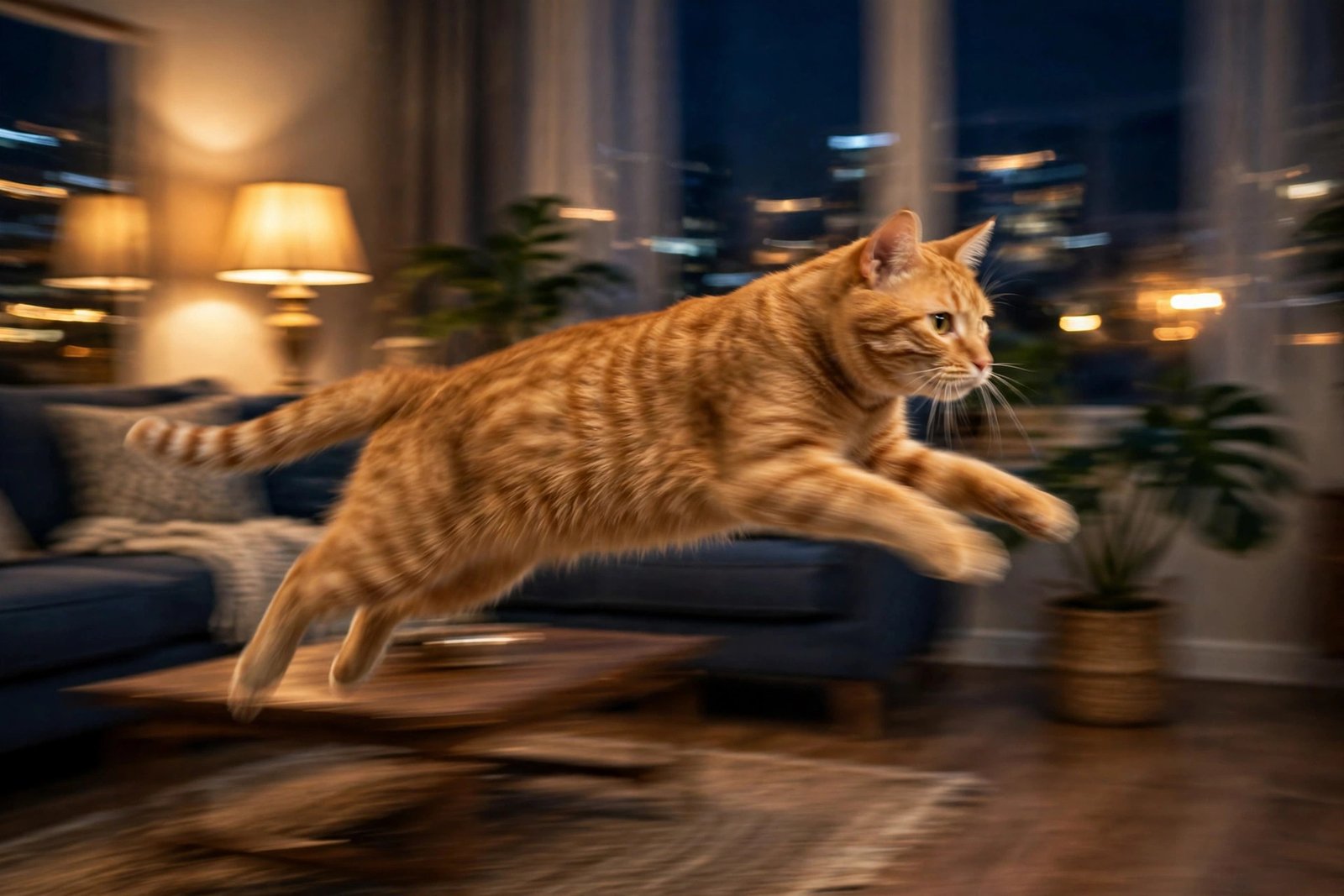
It is 3 a.m. You are sound asleep. Suddenly, a thundering gallop races down the hallway, something crashes off a shelf, and a furry blur tears across your bed and out the door again. Welcome to the zoomies. If you live with a cat, you know exactly what this is — and if you have ever lain awake wondering why do cats get zoomies at the worst possible hour, you are not alone. The good news is that zoomies are almost always normal, healthy, and even a sign of a happy cat. The bad news is that they tend to happen when you least want them to.
Zoomies are sudden bursts of frantic, seemingly random energy: sprinting from room to room, leaping onto furniture, skidding around corners, and sometimes attacking invisible enemies. Behaviorists call these episodes Frenetic Random Activity Periods, or FRAPs, and they are common in cats of all ages — although kittens and young adults are the most enthusiastic practitioners. Dogs get them too, usually after a bath, but cats have turned the zoomies into a nightly art form. Understanding why they happen, and how to manage them, can save your sleep and your sanity.
Why Do Cats Get Zoomies? The Science Behind the Sprints
Zoomies are not random, even though they look that way. They are a natural release of pent-up energy, and they serve a real purpose in a cat’s life. In the wild, cats spend their energy hunting — stalking, chasing, pouncing, and killing prey. A house cat does not need to hunt for its food, but it still has all of the same instincts and all of the same energy. When that energy builds up with nowhere to go, it comes out in a sudden, explosive burst. That burst is the zoomies.
There are several triggers that can set off an episode, and most cats have a pattern if you watch closely. Some cats get the zoomies after using the litter box. Some get them after eating. Some get them when the sun goes down, and some get them at the exact moment you turn off the light and get into bed. Knowing your cat’s triggers is the first step to managing the behavior — and to appreciating it for what it is: a healthy cat being a cat.
1. Pent-Up Energy From a Day of Sleeping
This is the biggest reason. Cats sleep for 12 to 16 hours a day, and a house cat that sleeps all day while you are at work wakes up in the evening with a full tank of energy and nothing to spend it on. In the wild, that energy would go into hunting. In your living room, it goes into a sprint from the couch to the kitchen, a leap onto the bookshelf, and a skid across the hardwood floor.
Kittens and young cats are the worst offenders, because they have the most energy and the least self-control. A kitten under a year old may have several zoomie episodes a day. Adult cats usually settle into one or two episodes, often in the evening. Senior cats get the zoomies less often, but when they do, it is a wonderful sign — a senior cat that still has a burst of playful energy is a healthy senior cat. If your cat is an only cat and spends most of the day alone, the evening zoomies are its way of burning off a whole day of stored energy at once. For more on feline energy and play needs, see our guide to why cats purr — a cat that plays hard and then purrs itself to sleep is a content cat.
2. Cats Are Naturally Most Active at Dawn and Dusk
Cats are crepuscular, which means they are naturally most active at dawn and dusk. This is an evolutionary leftover from their wild ancestors, who hunted at twilight when their prey — mice, birds, and other small animals — were also active. Your house cat does not need to hunt, but its internal clock still says that twilight is go time.
This is why the zoomies so often happen in the evening, just as you are settling down to watch television, and again in the early morning, just before your alarm goes off. Your cat is not trying to ruin your sleep on purpose. It is following a biological rhythm that is millions of years old. You can work with this rhythm rather than against it by scheduling play sessions in the early evening, which helps your cat burn off its twilight energy before you go to bed.
3. The Post-Litter-Box Victory Lap
Many owners notice that their cat gets the zoomies immediately after using the litter box. This is so common that it has a name among cat owners: the poop zoomies. There are a few theories about why this happens. One is simple relief — the cat feels lighter and more comfortable after relieving itself, and the burst of energy is a celebration. Another theory is that running helps the cat spread its scent and mark its territory after leaving a scent marker in the box.
A third theory is that the act of defecation stimulates the vagus nerve, which runs from the brain to the gut, and that stimulation can create a brief feeling of euphoria. Humans experience a version of this too — it is sometimes called poo-phoria. Whatever the cause, post-litter-box zoomies are completely normal, as long as your cat is using the litter box normally and not showing signs of pain or difficulty. If your cat cries while using the box, strains, or goes outside the box, that is a different matter — read our guide on why your cat suddenly stopped using the litter box for the warning signs to watch for.
4. The Post-Meal Energy Surge
Some cats get the zoomies right after eating, especially after their evening meal. Food provides a quick burst of energy, and a cat that has just eaten a satisfying meal may feel playful and energized. This is similar to the way a child gets a burst of energy after a meal and wants to run around the house.
This is normal, but it is worth noting that a cat that races around frantically after every meal and then vomits may be eating too fast. If that is happening, try a slow feeder bowl, which costs about $10 to $20, or spread your cat’s food across a puzzle feeder so it has to work for each bite. Smaller, more frequent meals can also help. If the vomiting continues, talk to your veterinarian, because it could be a sign of a food sensitivity or another digestive issue.
5. Hunting Instincts and Play
Zoomies are often a form of play hunting. Watch your cat during an episode and you will see the classic hunting sequence: stalk, chase, pounce, wrestle, and then run away to do it all again. Your cat may be chasing a dust mote, a shadow, a toy mouse, or nothing at all — but in its mind, it is hunting. This is healthy, enriching behavior, and it is important for your cat’s mental and physical well-being.
Cats that do not get enough play during the day are more likely to have intense, destructive zoomies at night, because they are trying to satisfy their hunting instincts all at once. The solution is not to stop the zoomies — it is to give your cat more structured play during the day so the hunting drive is satisfied before bedtime. A feather wand, a laser pointer, or a crinkle ball can all trigger the same hunting sequence in a controlled way. Ten to fifteen minutes of active play, twice a day, makes a remarkable difference.
6. Stress or a Change in the Environment
Not all zoomies are happy zoomies. Sometimes a sudden burst of frantic running is a stress response. A cat that has been frightened by a loud noise, a stranger, a new pet, or a trip to the veterinarian may tear around the house as a way to release adrenaline and cope with the stress. This type of zoomie looks different from a playful one: the cat’s body is tense, its ears are flat, its pupils are wide, and it may be running away from something rather than toward a toy.
If your cat’s zoomies started after a change in the household — a move, a new baby, a new pet, construction work — stress may be the cause. Give your cat a quiet, safe room to retreat to, keep its routine consistent, and consider a pheromone diffuser such as Feliway, which costs around $20 to $35 for a starter kit. If the frantic behavior continues or is paired with hiding, appetite loss, or litter box problems, talk to your veterinarian.
Are Zoomies Normal? When to Worry
For the vast majority of cats, zoomies are completely normal and nothing to worry about. They are a sign of a healthy, energetic cat with normal hunting instincts. Kittens and young adults get them most often, and they usually become less frequent and less intense as a cat ages. A cat that gets the zoomies is a cat that feels good enough to run, jump, and play — and that is something to be glad about.
There are a few situations where zoomies are worth a closer look. If your cat’s zoomies are new and sudden — a cat that has never done it before suddenly starts racing around frantically — it could be a sign of pain, anxiety, or a medical problem. Cats with hyperthyroidism, a common condition in older cats, can become hyperactive and restless. Cats with flea allergy dermatitis may run frantically because their skin is itchy and irritated — a condition sometimes called feline hyperesthesia, or twitchy cat syndrome, in which the skin along the back ripples and the cat suddenly sprints away as if something is chasing it.
Other warning signs include zoomies paired with excessive grooming, hair loss, dilated pupils that do not return to normal, aggression, or a cat that seems disoriented or distressed during the episode. If you notice any of these, or if the behavior is a dramatic change from your cat’s normal pattern, schedule a veterinary visit. A routine exam in the United States typically costs $50 to $100, and blood work to check thyroid function runs $100 to $250. The ASPCA notes that sudden behavior changes in cats should always be evaluated by a veterinarian, because cats are skilled at hiding illness and behavior is often the first clue. You can see what a visit typically costs in our article on how much a vet visit costs.
How to Manage the 3 AM Zoomies
You cannot eliminate zoomies entirely, and you should not try — they are a normal, healthy behavior. But you can manage them so they happen at a time that works better for you. The goal is to shift your cat’s energy expenditure from 3 a.m. to the early evening, and to make the middle of the night as boring as possible.
Start with a play session in the evening, about an hour before bed. Make it vigorous: use a feather wand to mimic a bird, or drag a toy mouse along the floor to mimic prey. Let your cat catch the toy at the end, because a hunt that ends in a catch is more satisfying than one that never does. Follow the play session with a small meal or a treat. This mimics the natural hunt-eat-groom-sleep cycle, and most cats will groom themselves and settle down to sleep within twenty minutes.
Next, make the night boring. If your cat wakes you at 3 a.m., do not get up, do not talk to it, and do not feed it. Any response teaches your cat that 3 a.m. zoomies get a reaction. It will take a few nights of ignoring the behavior, and the zoomies may get worse before they get better, but most cats learn within a week or two that nighttime is quiet time. Keep your bedroom door closed if you need to, and give your cat a comfortable sleeping area outside the bedroom with a cozy bed, fresh water, and a quiet toy.
During the day, make sure your cat has enrichment: a tall cat tree near a window, puzzle feeders, rotating toys, and cardboard boxes. A cat that is mentally stimulated during the day sleeps more soundly at night. If you are away during the day, consider an automatic toy or a timed feeder to keep your cat engaged while you are gone. And if you have a young, high-energy cat, consider whether a second cat might be a good fit — two cats can burn off energy playing with each other instead of using your bed as a racetrack at 3 a.m. That is a big decision, though, and it should be made carefully.
How to Play With Your Cat During the Zoomies
When your cat is mid-zoomie, it is tempting to join in — and you should, if it is daytime. Redirect that energy into a game. Grab a wand toy and let your cat chase it. Toss a crinkle ball down the hallway and watch your cat sprint after it. Hide treats around the house and let your cat hunt for them. This turns a chaotic burst of energy into a structured, satisfying play session, and it strengthens your bond at the same time.
There are a few safety rules. Never use your hands or feet as toys during the zoomies — a cat in full hunting mode does not distinguish between a toy and a hand, and you will get scratched or bitten. Never chase your cat during the zoomies, because being chased can feel threatening and turn play into fear. And make sure your cat’s zoomie routes are safe: secure tall bookshelves to the wall, move fragile items off open shelves, and keep cords and small objects out of the way. Cats can injure themselves by crashing into furniture or falling from a high perch during a frantic sprint. A little cat-proofing goes a long way.
If your cat’s zoomies involve scratching furniture during the sprint, that is often a separate issue — your cat may be marking territory or stretching its muscles. Our guide on how to stop cat scratching furniture has practical fixes, including scratching posts placed along your cat’s favorite running routes.
Do Cats Grow Out of the Zoomies?
Yes, mostly. Kittens are the most enthusiastic zoomers, and the behavior usually peaks between six months and two years of age. As cats mature, they become calmer and more settled, and the zoomies become less frequent and less intense. Most adult cats still get the occasional burst — often in the evening — but it is shorter and less destructive than a kitten’s full-throttle sprint.
Senior cats, aged ten and older, rarely get the zoomies, and when they do, it is usually a brief, joyful burst that lasts a minute or two. If your senior cat suddenly starts having intense, frequent zoomies after years of calm, it is worth mentioning to your veterinarian, because it can be a sign of hyperthyroidism or another medical issue. But in most cases, a senior cat that still gets the zoomies is simply a cat that still feels young at heart — and that is a wonderful thing to see.
The Bottom Line
So, why do cats get zoomies? Because they are natural hunters with a full tank of energy, a body clock that says twilight is go time, and a deep need to run, chase, and pounce. Zoomies are normal, healthy, and — once you understand them — even endearing. They are your cat’s way of being a cat in a world that does not ask it to hunt for its dinner.
You cannot stop the zoomies, and you should not want to. But you can shape them: play with your cat in the evening, feed it after play, make the night boring, and give it plenty of enrichment during the day. Do that consistently, and the 3 a.m. hallway Grand Prix will become a much rarer event — and when it does happen, you can smile, roll over, and let your cat enjoy its midnight sprint.
Frequently Asked Questions
Why do cats get zoomies at 3 AM?
Cats are most active at dawn and dusk, and they sleep most of the day, so they wake up with a full tank of energy in the middle of the night. A vigorous play session followed by a small meal in the evening helps shift that energy to bedtime.
Are cat zoomies a sign of happiness?
Usually, yes. Zoomies are a sign of a healthy, energetic cat with normal hunting instincts. A cat that runs, jumps, and plays is a cat that feels good. The exception is frantic running paired with fear, aggression, or skin twitching, which should be checked by a vet.
Why does my cat get zoomies after using the litter box?
Experts believe it is a mix of relief, scent-marking, and stimulation of the vagus nerve during defecation, which can create a brief feeling of euphoria. It is completely normal as long as your cat is using the box without pain or difficulty.
How long do cat zoomies last?
Most episodes last one to five minutes. Kittens may have several episodes a day, while adult cats usually have one or two, often in the evening. If an episode lasts much longer or your cat seems distressed, talk to your veterinarian.
Should I stop my cat from getting the zoomies?
No. Zoomies are normal, healthy behavior and an important outlet for your cat’s energy and hunting instincts. Instead of stopping them, redirect the energy into structured play during the day and evening so the episodes happen when you are awake.
1 thought on “Cat Zoomies: Why Cats Run Around at 3 AM”