
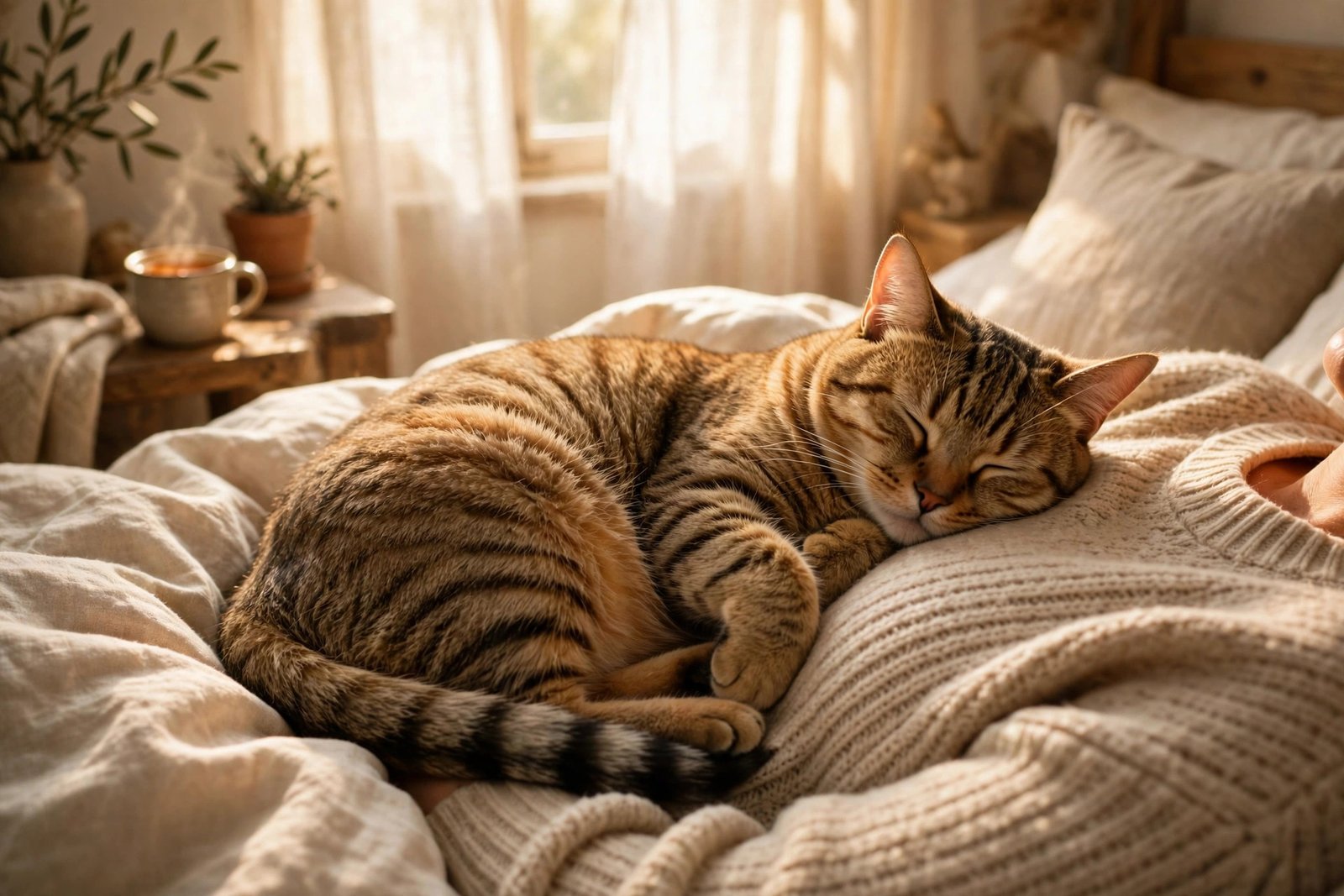
If you have ever woken up in the middle of the night with a warm, purring weight on your chest, your legs, or even your head, you have probably asked yourself: why does my cat sleep on me? It can feel flattering, a little confusing, and occasionally inconvenient — especially when your cat picks the exact spot where you need to roll over. The good news is that this behavior is almost always a compliment. Cats are famously independent animals, but they are also deeply social creatures who choose their sleeping partners carefully. When your cat curls up on you night after night, it is telling you something important about trust, comfort, and your bond.
Cats sleep for 12 to 16 hours a day, and kittens and senior cats can sleep even longer. That means your cat spends more than half of its life asleep, and where it chooses to sleep matters a great deal to it. Unlike dogs, who will happily flop down just about anywhere, cats are picky about their sleeping spots. They look for warmth, safety, comfort, and familiar smells. You, as it turns out, check every single one of those boxes. Understanding why your cat sleeps on you can help you enjoy the habit, manage it when it gets in the way of your sleep, and spot the rare occasions when a change in sleeping behavior might mean a trip to the veterinarian is in order.
Why Does My Cat Sleep on Me? The 7 Main Reasons
There is rarely just one reason behind this behavior. Most cats sleep on their owners for a combination of the reasons below, and the mix can shift from night to night. A cold winter evening might bring your cat to your chest for warmth, while a stressful day — a thunderstorm, a visit from a stranger, or a new piece of furniture — might send the same cat to your lap for reassurance. Here are the seven reasons behaviorists and veterinarians point to most often.
1. You Are Warm — and Cats Love Warmth
This is the simplest and most common reason. A cat’s normal body temperature runs between 100.4 and 102.5 degrees Fahrenheit, which is warmer than a human’s. Cats are heat-seekers by nature. That is why you will find them in sunbeams, on top of laptops, next to radiators, and curled up on the warmest spot in the house — which is often you. Your body is basically a large, soft, reliable heating pad that never gets unplugged.
Your chest and stomach are especially popular because they radiate steady warmth and rise and fall gently as you breathe. Your legs under a blanket create a warm, cave-like tunnel that many cats find irresistible. If your cat only sleeps on you during the colder months and spends summer nights stretched out on the tile floor, warmth is almost certainly the main driver. This is completely normal behavior, and it is one of the reasons cats in multi-cat households often pile together in a sleeping heap — they are sharing body heat, just like they did as kittens with their littermates.
2. Your Cat Trusts You Completely
Sleep is when a cat is at its most vulnerable. In the wild, a sleeping cat is an easy target for predators, so cats only sleep deeply in places where they feel safe. When your cat falls asleep on top of you, it is saying, in the clearest way a cat can, that it trusts you with its life. This is a big deal. Cats do not hand out that kind of trust casually, and it is earned over weeks and months of gentle, predictable care.
Notice how your cat sleeps on you: a deeply relaxed cat will go limp, stretch out, or even roll onto its back with its belly exposed. A cat that is only lightly dozing, with its ears twitching at every sound, is still keeping one eye open. The deeper the sleep, the deeper the trust. If you adopted a shy or rescue cat and it has only recently started sleeping on you, celebrate it — this is one of the clearest milestones that your cat now considers your home, and you, to be safe.
3. Your Scent Is Comforting
Cats live in a world of scent in a way humans can barely imagine. Your smell is one of the most familiar things in your cat’s life, and it signals safety and home. When your cat sleeps on you, it is surrounding itself with your scent, and at the same time, it is leaving its own scent on you. Cats have scent glands on their cheeks, forehead, chin, and paws, and they rub and knead to mix their scent with yours. That is the same reason behind the affectionate headbutt — a behavior often called bunting — that many cats perform before settling down for a nap.
This scent-sharing is also why your cat may sleep on your freshly laundered clothes, your side of the bed, or the pillow you used last night. Those items smell like you. If you have been away on a trip, do not be surprised if your cat is extra clingy at bedtime for the first few nights after you return. It is re-establishing that shared scent bond and making sure you smell like home again. Washing your bedding with a strongly scented detergent can sometimes make a cat less enthusiastic about the bed, simply because the familiar smell has been replaced.
4. Your Heartbeat and Breathing Are Soothing
When your cat sleeps on your chest, it can hear your heartbeat and feel the slow, steady rhythm of your breathing. That rhythmic sound is deeply calming to cats. Kittens fall asleep listening to their mother’s heartbeat, and that association stays with them for life. It is one of the reasons veterinarians sometimes recommend a ticking clock or a heartbeat toy, like the SmartPetLove Snuggle Puppy, for kittens adjusting to a new home.
Your breathing also creates a gentle rocking motion that can lull a cat to sleep, much like rocking soothes a baby. Many owners notice that their cat falls asleep fastest when they are lying still and breathing slowly, and wakes up the moment they shift position or reach for their phone. If your cat prefers your chest over every other spot in the house, the heartbeat and breathing rhythm is probably a big part of the appeal. It is also why cats often settle on you after a stressful event, such as a trip to the vet or a loud thunderstorm — your steady rhythm helps their own heart rate come down.
5. Your Cat Is Bonding With You
Cats may have a reputation for independence, but research has shown that they form strong attachment bonds with their owners, similar in some ways to the bonds dogs and even human infants form with their caregivers. A well-known study from Oregon State University found that cats use their owners as a secure base, much like children do with their parents. Sleeping together is one of the most intimate bonding behaviors a cat can offer. In feral cat colonies, cats that are bonded will sleep touching each other, often in a pile, while cats that merely tolerate each other sleep apart.
When your cat sleeps on you, it is choosing closeness over independence, and that choice is meaningful. This is especially true if your cat has other perfectly good sleeping spots — a heated cat bed, a sunny windowsill, a cat tree — and still picks you. Some cats show their bond in other ways too, like following you from room to room, greeting you at the door, or slow-blinking at you from across the room. If your cat does several of these things, you have a genuinely affectionate companion on your hands, no matter what the old stereotype about aloof cats says. For more on how cats show affection, read our guide to why cats purr — purring and sleeping on you often go together.
6. Your Cat Feels Safe With You Nearby
Safety and trust are related but not identical. A cat may trust you and still choose to sleep near you — rather than on you — because it wants to be close to its protector while keeping an escape route open. Cats that sleep directly on you have taken that one step further: they feel safest when they are in physical contact with you. Your presence, your smell, and your warmth together create a security blanket that no cat bed can match.
This is particularly common in cats that have had a frightening experience, such as being a stray, living in a shelter, or surviving a house with a loud dog. It is also common in kittens who have just been separated from their littermates. They are not being needy — they are doing what their instincts tell them to do, which is to stay close to the creature that keeps them fed, warm, and safe. If your cat only sleeps on you after something scary happens, like fireworks on the Fourth of July or a move to a new home, give it the extra closeness it is asking for. It will usually relax back into its normal routine once it feels secure again.
7. It Is a Habit — and a Routine Your Cat Loves
Cats are creatures of habit. They love routine, and they love it when the same good thing happens at the same time every day. If your cat has slept on you every night for a year, the behavior has become part of its daily rhythm, as automatic as its 5 a.m. request for breakfast. Cats learn quickly that your lap at 9 p.m. means a warm nap, and they will show up on schedule whether you are ready or not.
This is also why your cat may sleep on you in a specific spot at a specific time. The couch at 7 p.m. might be lap time, while 11 p.m. in bed might be chest time. Each spot and time has its own meaning in your cat’s routine. Disrupting the routine — going to bed late, sleeping in a different room, or closing the bedroom door — can genuinely unsettle a cat that is used to sleeping on you. If you need to change the routine, do it gradually, and offer an appealing alternative, like a heated cat bed placed right next to you, so your cat still feels included.
Where Your Cat Sleeps on You — and What It Means
Not all sleeping spots are equal, and where your cat chooses to sleep on you can tell you a little more about what it wants. A cat on your chest is usually seeking warmth and closeness, and it wants to hear your heartbeat. A cat on your legs is often a cat that loves you but also likes having an easy escape route — it is close, but it can leave in a hurry if something startles it. A cat curled up at your feet is keeping you in sight while staying a little more independent.
A cat that sleeps on your head or your pillow is usually after the warmth that escapes from your head, and the strong concentration of your scent on the pillow. It is also, honestly, a cat that has figured out that your head is the one part of you that does not move much during the night. A cat that sleeps on your stomach might be enjoying the gentle rise and fall of your breathing, and some owners notice their cats sleep on their stomach more often when they are not feeling well — although there is no scientific proof that cats can detect illness, they are very sensitive to changes in your routine, your temperature, and your smell.
Is It Safe to Let Your Cat Sleep on You?
For most healthy adults, letting a cat sleep on you is perfectly safe and can even be good for you. Studies have found that the presence of a purring cat can lower blood pressure and reduce stress, and many owners say they fall asleep faster with their cat nearby. However, there are a few situations where you should think twice.
People with cat allergies may find that a cat sleeping on their chest or face makes their symptoms worse overnight. If you have asthma or severe allergies, it is better to keep the cat off your pillow and out of the bedroom, or at least off the bed. Babies and very small children should never sleep with a cat unsupervised, because a cat could accidentally lie across an infant’s face. People with weakened immune systems should talk to their doctor about sleeping with pets, since cats can occasionally carry bacteria like Bartonella, which causes cat-scratch disease, or parasites if they go outdoors.
There is also the simple question of sleep quality. If your cat wakes you up repeatedly by walking on you, kneading with sharp claws, or demanding food at 4 a.m., your health matters too. A tired owner is not a good owner. It is okay to set boundaries, and it does not mean you love your cat any less. According to the American Veterinary Medical Association (AVMA), choosing a pet and a living arrangement that fits your household’s health and lifestyle is part of responsible pet ownership, and that includes making sleep arrangements that work for everyone.
When Sleeping on You Could Signal a Health Problem
Most of the time, a cat sleeping on you is a happy, healthy behavior. But a sudden change in where or how your cat sleeps can be a clue that something is wrong. Cats are masters at hiding pain and illness, so subtle behavior changes are often the first warning sign an owner will see. Watch for these red flags alongside the sleeping habit.
First, if your cat suddenly starts sleeping on you all the time after never doing it before, or becomes extremely clingy and refuses to leave your side, it could be a sign of pain, anxiety, or illness. Cats that are unwell often seek out their owner for comfort, just like a sick child wants a parent nearby. Second, if your cat is sleeping far more than usual — more than 18 to 20 hours a day for an adult cat — or seems lethargic and uninterested in play and food, that is worth a vet visit. Third, if your cat is seeking warmth obsessively, such as lying on heating vents or staying pressed against you constantly, it could be a sign of a fever, arthritis, or a thyroid problem. Older cats with arthritis often seek warm spots because the heat soothes their joints.
Other warning signs include a cat that suddenly stops sleeping on you after years of doing it, which can mean it is in pain and does not want to be touched, or a cat that cries or meows while settling down to sleep. If you notice any of these changes, especially combined with a loss of appetite, vomiting, diarrhea, or a change in litter box habits, call your veterinarian. In the United States, a routine vet visit typically costs $50 to $100, and catching a problem early is almost always cheaper — and kinder — than waiting. You can see a full breakdown of what to expect in our article on how much a vet visit costs.
How to Enjoy It — and Set Boundaries When You Need To
If you love having your cat sleep on you, there is nothing you need to change. Enjoy it. You can make the experience better for both of you by keeping a soft blanket on your lap, trimming your cat’s nails regularly so kneading does not hurt, and keeping a consistent bedtime so your cat knows when cuddle time starts. Many owners find that a short play session before bed — ten minutes with a feather wand or a laser pointer — helps their cat settle into a deeper, calmer sleep on top of them instead of treating them as a midnight playground.
If the habit is disrupting your sleep, you do not have to banish your cat from the bedroom entirely. Start by giving your cat an appealing alternative right next to you: a heated cat bed, a cat cave, or a folded blanket on the bed beside you. Reward your cat with a treat or a chin scratch whenever it uses the new spot. If your cat wakes you at night, resist the urge to feed it or play with it, because that teaches the cat that waking you up works. Instead, gently move the cat to its own spot and go back to sleep. Consistency is everything — if you give in at 4 a.m. on Tuesday after ignoring it on Monday, your cat will learn that persistence pays off.
Some owners find that closing the bedroom door is the only thing that works, and that is a valid choice too. If you go this route, make the transition gradually. Set up a comfortable sleeping area outside the bedroom with a cozy bed, fresh water, and a quiet toy, and start by closing the door for part of the night. Your cat may protest loudly for a few nights — cats are famously stubborn about closed doors — but most adjust within a week. You can also try a white noise machine to mask the sound of your cat meowing at the door.
Why Does My Cat Sleep on Me Instead of Its Own Bed?
This is one of the most common follow-up questions owners ask, usually while looking at the expensive heated cat bed their cat ignores every night. The answer is simple: your cat’s bed, no matter how plush or well-designed, cannot compete with you. You are warmer, you smell like home, you breathe in a soothing rhythm, and you are the cat’s favorite person. A cat bed is an object. You are a relationship.
That said, you can make a cat bed more appealing. Place it where your cat already likes to sleep, ideally near you and in a warm, draft-free spot. Put a worn T-shirt that smells like you in the bed. Try a heated pad designed for cats, which typically costs $25 to $45 in the United States, or a self-warming mat that reflects the cat’s own body heat back at it. Some cats prefer an enclosed cave bed, while others like an open perch with a view. Experiment with a couple of styles — but do not take it personally if your cat still prefers you. That is a compliment, not a rejection of the bed.
The Bottom Line
So, why does my cat sleep on me? Because you are warm, you smell like home, your heartbeat is soothing, and — most importantly — your cat trusts you and loves being close to you. It is one of the highest compliments a cat can pay, and it is a sign of a strong, healthy bond between you and your pet. Enjoy those quiet, purring moments. They are your cat’s way of saying that out of every warm, soft spot in the house, you are its favorite.
Pay attention to sudden changes in the habit, keep your cat’s nails trimmed, and set gentle boundaries if your sleep is suffering. But on most nights, the best thing you can do is lie still, listen to the purring, and let your cat sleep on you. It has chosen you, and that is a pretty wonderful thing.
Frequently Asked Questions
Why does my cat sleep on me every night?
Your cat sleeps on you every night because you are warm, familiar, and safe. Nighttime is when cats are most vulnerable, so choosing you as a sleeping spot means your cat trusts you completely. It has also become a comforting routine, and cats love routines.
Why does my cat sleep on my chest specifically?
Your chest is warm, it rises and falls gently with your breathing, and your cat can hear your heartbeat there. That steady rhythm is deeply soothing to cats and reminds them of sleeping next to their mother as kittens.
Is it bad to let my cat sleep on me?
For most healthy adults it is perfectly fine and can even lower stress and blood pressure. It is not recommended for babies or very small children, and people with severe cat allergies, asthma, or weakened immune systems should talk to their doctor first.
Why did my cat suddenly start sleeping on me?
A sudden change can mean your cat is cold, anxious, or not feeling well and is seeking comfort. It can also follow a stressful event like a move, a new pet, or fireworks. If the clinginess comes with appetite loss, lethargy, or litter box changes, schedule a vet visit.
How can I get my cat to sleep in its own bed instead of on me?
Place a warm, cozy bed right next to you, add a worn shirt that smells like you, and reward your cat for using it. A heated cat bed can help. Be consistent and patient — most cats adjust within a week or two if the alternative is warm and close to you.
1 thought on “Why Does My Cat Sleep on Me?”