
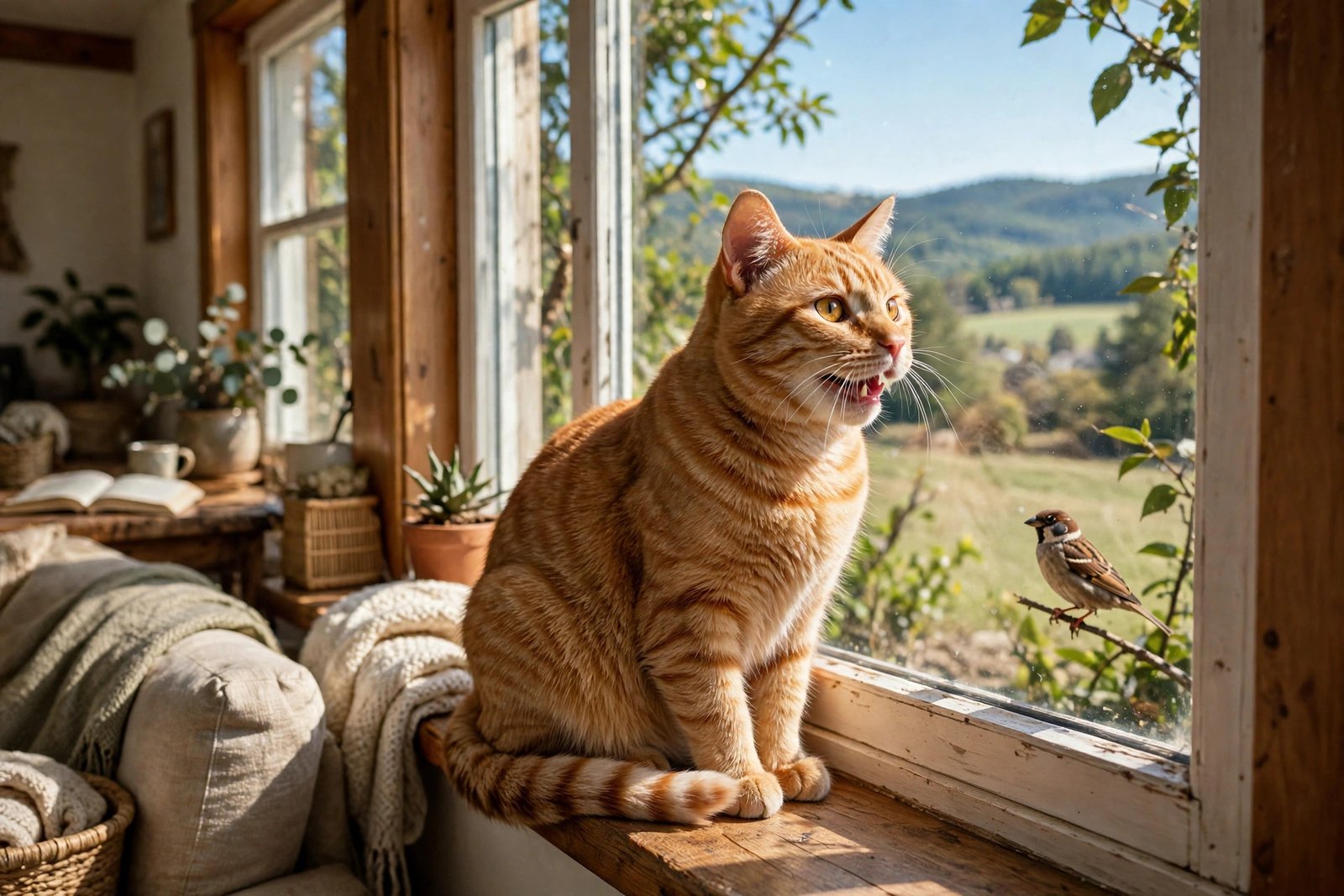
If you have ever watched your cat lock eyes on a bird through the window and start making a strange, rapid clicking sound with its jaw, you have witnessed one of the most curious behaviors in the feline world. Why do cats chatter at birds is a question almost every cat owner asks the first time they hear it, because the sound is so unlike a meow, a purr, or a chirp. It is a fast, stuttering chatter, sometimes mixed with a high-pitched squeak, and it usually comes with a fixed stare, twitching tail tip, and a body held perfectly still. Your cat looks completely focused, almost frustrated, and a little bit thrilled at the same time. That combination is exactly what makes chattering so fascinating, and so confusing, to the humans watching it.
The short answer is that chattering is a normal, instinctive hunting behavior. When a cat sees prey it cannot reach, especially a bird on the other side of a window, its brain switches into full predatory mode. The jaw movements you see are widely believed to mimic the killing bite a cat uses to dispatch small prey, a quick bite to the back of the neck. In other words, your cat is rehearsing the hunt. It is not angry at you, it is not broken, and it is not trying to talk to the bird. It is a hunter whose instincts have been triggered by something it can see but cannot catch, and the chatter is the sound of that instinct spilling over.
That said, there is more going on than simple frustration. Researchers and veterinarians have proposed several overlapping explanations for chattering, and most likely more than one of them is true at the same time. Some cats chatter only at birds, others chatter at squirrels, insects, lizards, and even at a feather toy dangling just out of reach. Some cats do it loudly every single day, while others rarely do it at all. Understanding what drives the behavior helps you know when to enjoy it, when to give your cat a better outlet, and when it might actually be a sign of a dental or neurological problem that deserves a vet check.
Why Do Cats Chatter at Birds? The Hunting Instinct Explained
To understand why do cats chatter at birds, it helps to start with how cats hunt in the wild. A domestic cat is a small, solitary ambush predator. Its ancestors hunted birds, mice, and other small animals by stalking quietly, freezing, and then pouncing in a single explosive burst. The final step of that sequence is the killing bite: a precise bite to the neck that severs the spinal cord. Cats practice the jaw movements for that bite from a very young age, and the chattering motion looks remarkably like a rapid-fire version of it.
When your cat is sitting at the window watching a robin hop around the yard, its brain is running through the entire hunting sequence. It has spotted prey, it has locked on, and it is ready to stalk and pounce. But the window is in the way. The cat cannot complete the sequence, so the energy has nowhere to go. Many behaviorists believe the chattering is that pent-up predatory energy leaking out as a jaw tremor. The cat is essentially saying, in body language, “I know exactly what I would do if I could get to that bird,” and the jaw is rehearsing the bite over and over again.
This also explains why chattering is most common in indoor cats. An outdoor cat that actually catches birds does not need to rehearse as much, because it gets to complete the hunt. An indoor cat, on the other hand, watches prey all day through glass and never gets the payoff. The frustration builds, and the chatter is one way it shows. That does not mean your indoor cat is unhappy. In fact, watching birds through a window, often called “cat TV,” is one of the best forms of enrichment you can offer an indoor cat. The chattering is a sign your cat is engaged, stimulated, and thinking like the hunter it was born to be.
There is also a second theory that is worth knowing about. Some researchers have suggested that the chattering sound may be an attempt at mimicry. Certain wild cats are known to imitate the calls of their prey to lure them closer. The margay, a small wild cat from Central and South America, has been observed mimicking the cries of baby monkeys to draw adult monkeys within striking range. Could domestic cats be doing something similar when they chirp and chatter at birds? It is an intriguing idea, and it would explain why the sound is so bird-like in some cats, almost a squeaky chirp rather than a jaw click. The evidence for mimicry in house cats is still thin, and most veterinarians consider it a secondary explanation at best, but it is a reminder that cats are far more sophisticated hunters than we often give them credit for.
A third explanation is simpler and more emotional: excitement and frustration mixed together. Think about how you feel when you are watching a game and your team is about to score, but the play gets stopped. You might groan, clench your jaw, or mutter under your breath. Cats do something similar. The chatter is an involuntary response to intense excitement that cannot be acted on. The cat is aroused, focused, and a little bit annoyed, and the jaw trembles as a result. This is why some cats also chatter when they see a laser pointer dot they cannot catch, or a fly buzzing on the ceiling just out of reach.
What Does Cat Chattering Sound Like?
If you have never heard it before, cat chattering can be startling. It is not a sound most people associate with cats. The classic description is a rapid “ek-ek-ek” or “ack-ack-ack” clicking, made by the jaw opening and closing very quickly while the teeth clack together. Some cats add a high-pitched chirp or squeak between clicks, which makes the whole thing sound almost like a bird call itself. Other cats do a softer version, more of a jaw tremble with very little sound, where you can see the lower jaw vibrating but barely hear anything.
Chattering is different from chirping, though the two are often confused. A chirp is a short, melodic trill, usually a greeting or an invitation to play. Many cats chirp at their owners when they come home, or chirp at a toy they want you to throw. Chattering is faster, more mechanical, and almost always directed at prey the cat cannot reach. A cat that is chirping is usually relaxed and happy. A cat that is chattering is usually tense, focused, and locked onto a target.
It is also different from the teeth chattering you might see in a cold or frightened cat, and different from the jaw trembling that can come with dental pain. Context matters enormously. If your cat only chatters when it is staring at a bird, a squirrel, or a bug, and it stops the moment the prey disappears, that is classic hunting chatter. If your cat chatters randomly, while eating, or while doing nothing at all, that is a different story and one worth mentioning to your veterinarian.
Is Chattering Normal, or Should You Worry?
For the vast majority of cats, chattering is completely normal. It is one of those behaviors that looks odd to humans but is perfectly natural for a cat. Kittens as young as a few months old will start chattering at birds, and many cats keep doing it their whole lives. There is no need to stop it, train it out of your cat, or worry that it means your cat is stressed or unhappy. In fact, a cat that chatters at birds is usually a cat that is getting good mental stimulation from its environment.
That said, there are a few situations where chattering deserves a closer look. If your cat starts chattering suddenly after never doing it before, especially if it is an older cat, pay attention to what else is going on. Is your cat eating normally? Is it drooling, pawing at its mouth, or avoiding hard food? Dental disease is very common in cats, affecting most cats over the age of three to some degree, and jaw pain or tooth problems can cause odd mouth movements that look a bit like chattering. A cat with a sore tooth may chatter when it tries to eat, or may make clicking sounds while grooming. If the chattering happens away from the window and seems linked to eating or mouth discomfort, a dental check is a smart move. A routine vet visit in the United States typically costs $50 to $80 for the exam itself, with dental cleaning running $300 to $800 depending on your area and whether extractions are needed, so catching dental problems early can save you money as well as sparing your cat pain. For more on what vet care costs, see our guide to how much a vet visit costs.
Seizures are another, much rarer cause of repetitive jaw movements. A focal seizure can cause a cat’s jaw to twitch or chatter for a few seconds, sometimes with drooling or a glazed expression. The key difference is that seizure-related chattering does not line up with prey. If your cat chatters while staring at a blank wall, or seems dazed and unresponsive during the episode, record a video and show it to your veterinarian. Do not try to diagnose this yourself. A short video clip is enormously helpful for a vet, because these episodes are hard to describe in words and almost never happen in the exam room.
Some cats also chatter more when they are overstimulated or frustrated in general. If your cat chatters at the window and then turns around and swats at you, or bites during petting, it may be experiencing redirected aggression. The cat is so worked up by the bird it cannot catch that the arousal spills over onto the nearest available target, which unfortunately might be your hand. If this happens, give your cat space. Do not pick it up or try to soothe it with petting while it is still fixated on the window. Let it calm down on its own, and consider closing the blinds for a few minutes to break the fixation.
Why Do Some Cats Chatter and Others Never Do?
Not every cat chatters, and that is normal too. Just like some cats are enthusiastic purrers and others rarely purr, chattering varies a lot from one individual to another. Breed may play a small role. Siamese, Abyssinians, Bengals, and other high-energy, prey-driven breeds seem to chatter more often, probably because they have stronger hunting drives. But plenty of ordinary domestic shorthairs chatter every day, and plenty of Bengals never do. Personality, early life experience, and how much access a cat has to windows all matter.
Kittens that grow up watching birds from a young age seem more likely to develop the habit. Cats that were raised outdoors and hunted as youngsters may chatter less as adults, because they have actually completed hunts and do not need to rehearse as much. Indoor-only cats that spend hours at the window tend to be the most dedicated chatterers. Age can matter as well. Young adult cats, roughly one to six years old, tend to chatter the most, when their hunting drive is at its peak. Senior cats may chatter less as their eyesight dims and their interest in prey fades, though many older cats keep the habit for life.
If your cat has never chattered, there is nothing wrong with it. It does not mean your cat is less of a hunter, less intelligent, or less engaged with its surroundings. Some cats express their hunting excitement in other ways, like the sudden burst of energy known as the zoomies, or a low crouching stalk across the living room floor. If you want to learn more about those bursts, read our article on why cats get the zoomies. Every cat has its own way of being a cat, and chattering is just one item on a long menu of normal feline behaviors.
What Your Cat’s Body Language Is Telling You While It Chatters
The chatter itself is only part of the picture. Watch the rest of your cat’s body and you will get a much fuller story. A chattering cat usually has wide, dilated pupils, ears pointed forward, and whiskers pushed out toward the target. The body is low and still, often crouched, with the tail tip twitching or flicking side to side. This is the classic stalking posture. Your cat is not relaxed. It is in full concentration mode.
Sometimes you will also see your cat’s butt wiggle, that funny little back-and-forth shake cats do right before they pounce. The butt wiggle is believed to help the cat gain traction and test its footing before launching. If you see the wiggle combined with chattering, your cat is at peak hunting excitement and is about to try to pounce on the window, or at least on the windowsill. It is harmless and hilarious, and it is one of the best reasons to keep a sturdy cat perch by the window.
After the bird flies away, most cats will do a little reset. They may groom themselves, stretch, yawn, or walk away and find a sunny spot to nap in. That quick shift from intense focus to total relaxation is very cat-like. They can go from zero to one hundred and back to zero in seconds. If your cat stays agitated for a long time after the bird leaves, pacing, meowing loudly, or acting restless, it may need more play and enrichment to burn off that predatory energy. A ten-minute play session with a wand toy can work wonders.
How to Give Your Cat a Healthy Outlet for Its Hunting Drive
Since chattering is driven by the hunting instinct, the best thing you can do for a dedicated chatterer is to give that instinct a proper outlet. A cat that gets to hunt, even in play, is a happier and calmer cat. Here are practical ways to do that in a typical American home.
Set up a bird-watching station
Give your cat a comfortable, secure perch by its favorite window. A suction-cup window hammock costs $20 to $35, and a sturdy cat tree placed by the window runs $60 to $150. Put a bird feeder outside that window, about ten to fifteen feet away, so birds visit regularly but stay safely out of reach. Your cat gets hours of entertainment, and you get to enjoy watching your cat enjoy it. The Cornell Lab of Ornithology offers excellent guidance on bird-friendly yards and feeders that keep visiting birds safe. Make sure the window has a secure screen, because an excited cat can push through a loose screen more easily than most owners expect.
Play like prey
Wand toys that mimic a bird or a mouse are the gold standard for indoor hunting play. Move the toy in short, darting bursts, let it hide behind furniture, and let your cat catch it at the end. A play session should end with a catch, followed by a small treat or a meal, so your cat gets the full sequence: stalk, chase, catch, eat. This is far more satisfying than a laser pointer, which your cat can never actually catch and which can increase frustration in some cats. If you do use a laser pointer, always end the game by pointing it at a physical toy or treat your cat can grab.
Aim for two play sessions a day, ten to fifteen minutes each, especially for young or high-energy cats. Morning and evening work best, because those are the times cats are naturally most active. A tired cat is a content cat, and a cat that has just had a good play session is much less likely to sit at the window chattering in frustration for hours.
Try puzzle feeders and food enrichment
In the wild, cats work for their food. In most homes, food appears in a bowl twice a day with no effort at all. Puzzle feeders, snuffle mats, and treat-dispensing balls reintroduce a little bit of that work and give your cat’s brain something to do. A basic puzzle feeder costs $10 to $25, and you can also make one at home by hiding kibble in a muffin tin covered with tennis balls. Start easy and make it harder as your cat learns. This is especially useful for cats that chatter a lot at night or early in the morning, because a puzzle feeder can keep them occupied during those restless hours.
Rotate toys and add vertical space
Cats get bored with the same toys, just like people get bored with the same routine. Keep a small rotation of toys in a drawer and swap them out every few days. Add vertical space with cat shelves or a tall cat tree, because cats feel more secure and more stimulated when they can climb and look down on their territory. A cat with a rich environment has less need to fixate on the window for hours at a time.
When Chattering Might Mean a Trip to the Vet
Most chattering is harmless, but it is worth knowing the red flags. Book a vet visit if you notice any of the following alongside the chatter: drooling or pawing at the mouth, difficulty eating or dropping food, bad breath that is new or much worse than usual, chattering that happens with no prey in sight, episodes where your cat seems dazed or unresponsive, or any sudden change in a senior cat’s behavior. These can point to dental disease, oral pain, or a neurological issue, and all of them are easier and cheaper to treat when caught early.
When you go to the vet, bring a video of the behavior if you can. Vets see dozens of cats a day, and a thirty-second clip of your cat chattering at the window tells them far more than a verbal description. Note when it happens, how long it lasts, and whether your cat seems normal immediately afterward. That information helps your vet decide quickly whether this is normal hunting behavior or something that needs tests. The American Veterinary Medical Association (AVMA) has a helpful guide to normal cat behavior and when to seek care, which is a good reference for any new cat owner.
It is also worth mentioning that cats are masters at hiding pain. A cat with a sore tooth may still eat, play, and chatter at birds, because in the wild showing weakness is dangerous. That is why annual wellness exams matter so much. Your vet can check your cat’s teeth, gums, and jaw during a routine visit and catch problems long before they become obvious at home. If your cat is due for a checkup, a chattering question is a perfect thing to raise during the appointment.
Fun Facts About Cat Chattering
Chattering is not unique to house cats. Big cats do versions of it too. Cheetahs are famous for chirping and chattering at birds, and their calls can sound so bird-like that researchers have studied them for years. Jaguars and ocelots have also been observed making chattering sounds while watching prey. The behavior seems to be deeply wired into the feline brain across species, which makes sense when you remember that all cats, from a five-pound house cat to a two-hundred-pound lion, share the same basic hunting toolkit.
Another fun detail is that cats sometimes chatter at things that are not prey at all. Some cats chatter at falling snow, at raindrops on the window, or at a moth fluttering around a light. Others chatter at their own reflection, or at a cat on television. Anything that triggers the “small, moving, out of reach” response can set it off. If your cat chatters at the television during a nature documentary, congratulations, you have a cat with excellent taste in programming.
Finally, there is some evidence that cats can learn to chatter from other cats. Kittens raised with an older cat that chatters seem to pick up the behavior more quickly than kittens raised alone. Like many cat behaviors, chattering is partly instinct and partly learned, which is one more reason every cat does it a little bit differently.
The Bottom Line
So, why do cats chatter at birds? Because they are hunters, and a bird on the other side of the glass is the ultimate tease: close enough to see, too far away to catch. The chattering jaw is most likely a rehearsal of the killing bite, mixed with excitement and a healthy dose of frustration. It is normal, it is common, and in most cases it is a sign that your cat is engaged and stimulated, not stressed or sick. Enjoy the show, give your cat a good window perch and plenty of play, and only worry if the chatter shows up without prey, comes with eating problems or drooling, or looks like your cat is dazed rather than focused. In those cases, a video and a vet visit will sort it out quickly. For everyone else, the next time your cat starts clicking at a robin, just pull up a chair and watch. You are seeing a tiny, perfect predator doing exactly what it was built to do.
Frequently Asked Questions
Why do cats chatter at birds through a window?
Because the bird triggers their hunting instinct but the window prevents them from completing the hunt. The rapid jaw movement is believed to mimic the killing bite, and it is a mix of excitement and frustration at prey they can see but cannot reach.
Is it normal for cats to chatter at birds?
Yes, it is completely normal. Most cats chatter at birds, squirrels, insects, or toys they cannot reach. It is a common hunting behavior in healthy cats of all ages and usually means your cat is stimulated and engaged.
Why does my cat chatter but my other cat never does?
Chattering varies by individual cat. Some cats are more prey-driven, more excitable, or had more window-watching experience as kittens. A cat that never chatters is not abnormal; it simply expresses its hunting drive in other ways, like stalking, pouncing, or the zoomies.
Can chattering mean my cat has dental problems?
It can, but only when the chattering happens away from prey, during eating, or with drooling, pawing at the mouth, or dropped food. Chattering that only happens while staring at a bird is almost always normal hunting behavior, not a dental problem.
How can I stop my cat from chattering at birds?
You do not need to stop it, since it is normal and harmless. If it bothers you or your cat seems frustrated, close the blinds for a while, offer a wand-toy play session that ends with a catch and a treat, or set up a puzzle feeder to redirect that hunting energy.